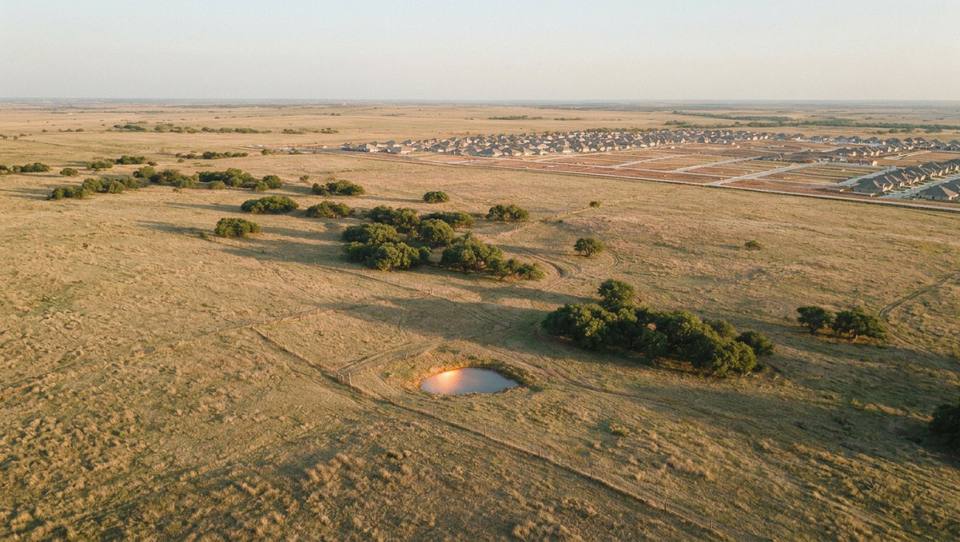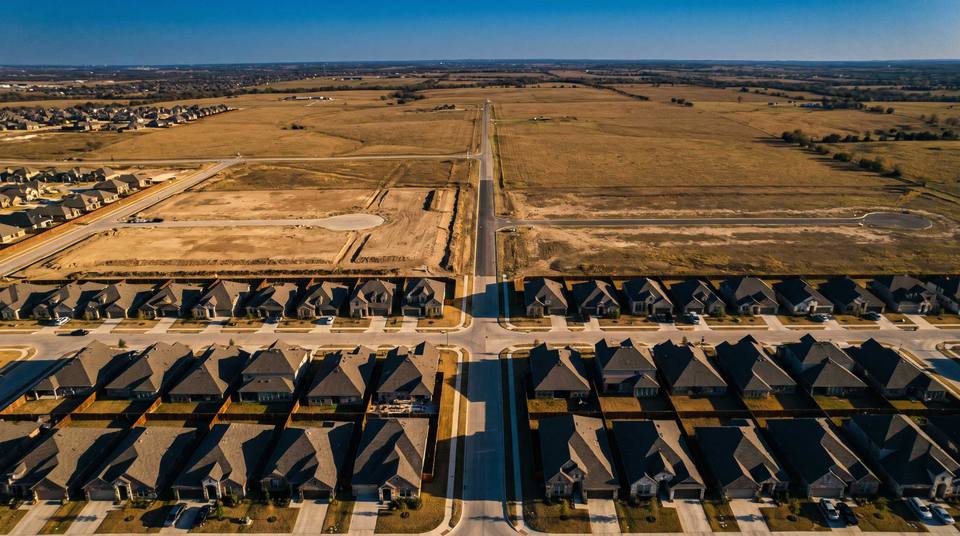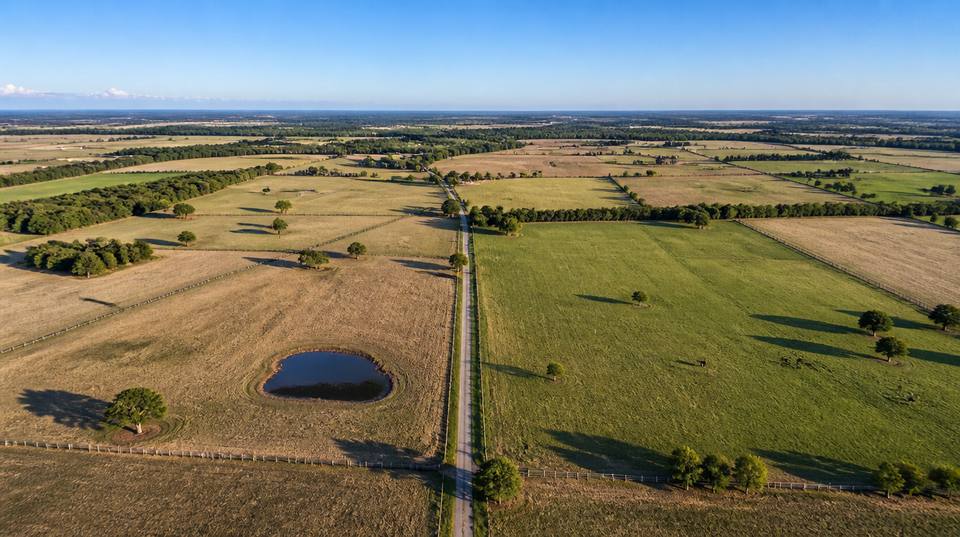
A seller has 100 acres. A cash buyer wants five of those acres carved off the corner, and wants to close soon. The seller has already been told this part is simple: Texas counties have no zoning, a metes and bounds deed is all it takes, and nobody has to approve anything.
He is right about the zoning. He is wrong about the other two, and the last one is what kills the deal. Whether a Texas plat exemption applies is governed by Chapter 232 of the Local Government Code, and the acreage everyone quotes is only half of a two-part test.
Most land professionals in North Texas have split tracts for years without ever setting foot in commissioners court. That is not because the rule does not exist. It is because those particular tracts qualified for a Texas plat exemption. Change one variable and the same deal lands on a court agenda.
The default rule every Texas plat exemption works against
Section 232.001(a) is blunt. The owner of a tract outside city limits must have a plat prepared if the owner divides it into two or more parts. That applies to laying out a subdivision, laying out lots, or laying out streets, alleys, squares, parks, or other parts intended for public dedication.
Section 232.002 then requires the commissioners court to approve that plat by order entered in the minutes. Platting is not a filing. It is an approval.
Counties have no general zoning authority in Texas, which is where the "no rules out here" myth starts. What they do have is platting authority, and it reaches nearly every division of raw land outside a municipality. The same gap is what lets a tract in a city's extraterritorial jurisdiction develop without city zoning review, a dynamic that played out in the McKinney MF36 annexation and zoning case.
The exceptions do not care how the deed is written, either. Section 232.001(a-1) counts a division no matter how it is made: metes and bounds, contract for deed, contract of sale, anything else. The legislature wrote that sentence because people kept trying it.
Every Texas plat exemption in Section 232.0015
Section 232.0015 is where the real work happens. Each exception below describes a situation where a county may not require a plat.
| Statute | Exception | The catch |
|---|---|---|
| 232.0015(c) | Land used primarily for agricultural, farm, ranch, wildlife management, or timber production use | No acreage floor at all, but subsection (d) reinstates the plat requirement the moment the land stops being used that way |
| 232.0015(e) | Four or fewer parts, each transferred to someone related within the third degree by consanguinity or affinity | One lot to a non-relative and the exception disappears for the entire division |
| 232.0015(f) | All lots more than 10 acres | Every resulting tract must clear it, including the remainder |
| 232.0015(g) | All lots sold to veterans through the Veterans Land Board program | Narrow by design |
| 232.0015(j) | Two parts, one retained by the owner, the other transferred to a buyer who will plat it | The buyer inherits the platting obligation |
| 232.0015(k) | All parts transferred to people who already held an undivided interest | A plat must be filed before any further development |
Every Texas plat exemption above carries the same second condition: the owner does not lay out streets, alleys, squares, parks, or other parts intended for public dedication.
That is the half nobody quotes. Acreage alone exempts nothing. Two 50-acre tracts fronting an existing county road qualify. Two 50-acre tracts where the back parcel needs a new dedicated road do not qualify at any size.
Running the seller's numbers
Go back to the 100 acres and the five-acre buyer. Under 232.0015(f), every lot the division creates has to be more than 10 acres. This division creates two: the five-acre tract going to the buyer, and the 95 acres the seller keeps. The 95 clears the threshold. The five does not. One failing lot disqualifies the whole division.
Nothing in that subsection caps the number of parts. Divide the same 100 acres into five 20-acre tracts with frontage on an existing public road and no new dedication, and every lot clears. The exemption does not care how many pieces you make. It cares whether every single piece is over the line.
Note the exact wording: more than 10 acres. A lot that surveys at exactly 10.00 acres does not clear it, and that one lot takes the whole division down with it. Surveyors round to the nearest hundredth. Get the surveyed number before you write the contract, not after.
Ten acres is a ceiling on the county, not a floor for the owner
Read the operative language again. Every subsection says a county may not require a plat. Those are limits on county power, not the outer boundary of what a county may excuse.
Section 232.0015(a) makes it explicit. A county may define and classify divisions to determine which must be platted, and need not require platting for every division within the subchapter's scope. Counties use that authority constantly, which means a Texas plat exemption granted locally can be broader than the one the statute guarantees. Some route small divisions with existing road frontage into a lighter review track. Some have dropped their working threshold below 10 acres, in cases to just above five.
They also move it back. One East Texas county in a growth corridor replaced an automatic small-tract allowance with a discretionary waiver, granted case by case only by order of the commissioners court. Divisions that had been automatic became requests. Projects already underway, splitting land into five to seven acre tracts, suddenly needed a hearing date.
Two things follow. Call the county before you quote a threshold, because the number in the statute may not be the number the county applies. And treat a local threshold as policy, not protection. A county can amend its regulations at the next commissioners court meeting. Section 232.0015(f) cannot be amended by anyone but the legislature.
In the ETJ, the threshold depends on who reviews
This is where a Texas plat exemption gets misapplied most often in Collin, Denton and Grayson counties. Section 232.0015 limits county authority. It says nothing about cities.
Chapter 212 sets a different bar. Section 212.004(a) exempts a division into parts greater than five acres where each part has access and no public improvement is dedicated. Five, not ten.
Which number applies depends on Chapter 242. Since House Bill 1445 passed in 2001, a city and county may not both regulate subdivisions in the same ETJ. They must execute a written agreement naming which entity approves plats there, or apportioning the ETJ between them. If that agreement puts the county in charge of your tract, the 10-acre test governs. If it puts the city in charge, five acres governs. A seven-acre lot is exempt under one and not the other.
So a Texas plat exemption in the ETJ depends on a document most agents never ask for. Two questions belong in every listing appointment: whose ETJ, and what does the 1445 agreement say. The second is a document you can request and read. Senate Bill 2038 lets landowners petition out of a city's ETJ entirely, and the boundary fights that follow are already in court, as the Willow Park annexation lawsuit shows. Treat it as a conversation with a land attorney, not a checkbox.
Keeping the deal alive when no Texas plat exemption applies
Property Code Section 12.002 gives the rule teeth. A person may not use a subdivision's description in a deed, contract for deed, or executory contract delivered to a purchaser unless the plat has been approved and filed. Violation is a misdemeanor carrying a fine of $10 to $1,000, up to 90 days in county jail, or both. Each violation is a separate offense and prima facie evidence of intent to defraud.
Subsection (d) is the part agents miss. A contract to convey may use the subdivision description before the plat is approved if two conditions hold: the conveyance is expressly contingent on approval and recording of the final plat, and the buyer is not given use or occupancy before that recording.
That is how the five-acre buyer stays under contract while the plat runs. Losing a Texas plat exemption does not require losing the deal. It requires writing the contract correctly.
The clock is defined. Under Section 232.0025, the county must approve, conditionally approve, or disapprove within 30 days of a completed application, and an application not disapproved in that window is approved. The period extends another 30 days only if the applicant agrees in writing, and the county may not require an applicant to waive the timeline at all. Read that last part twice before signing anything a plat coordinator hands you.
The condominium question the legislature left open
There is one more way around the plat requirement, and it is the one sophisticated developers actually reach for. Not a metes and bounds deed. A condominium regime. Property Code Section 82.006 says a condominium declaration is not a subdivision, and the clerk records it without prior approval. But Section 82.051(e) preserves local plat authority, and Attorney General Opinion GA-0223 concluded counties may treat a condominium that divides land into distinct sites as a subdivision.
House Bill 4812 and Senate Bill 2703 would have barred any plat requirement for creating one. SB 2703 passed the Senate and died on third reading in the House. The site condominium remains a viable but contested route to a Texas plat exemption, and the answer still turns on your county.
A Texas plat exemption has to be documented, not assumed
Collin County has tightened. Even when a division qualifies, county regulations require the owner to file an Application for Formal Determination of Exemption Status with the Director of Engineering, specifically to prevent misapplication of an exemption.
Counties also set their own standards under Chapter 232 for road frontage, right-of-way width, drainage, and on-site sewage facilities. Assuming a Texas plat exemption applies is not the same as documenting that it applies. The clerk's office is where that assumption gets tested, and by then the seller has already signed something.
One currency note. Section 232.0015 was amended effective September 1, 2025 by House Bill 3680, but only to cross-reference a new subchapter covering border and Gulf counties. Nothing changed for North Texas.
Quick answers on Texas plat exemption rules
Can I split 100 acres into two 50-acre tracts without commissioners court approval?
Generally yes, if both tracts have access without dedicating a new public road and the county holds review authority there. Section 232.0015(f) exempts divisions where all lots exceed 10 acres and nothing is laid out for public use.
Is there a limit on how many tracts I can create?
Not under 232.0015(f). Five 20-acre tracts out of 100 acres earn the same Texas plat exemption as two 50-acre tracts. Only the family transfer exception caps the count, at four or fewer.
Can I carve five acres out of a larger tract and sell it?
Not without a plat, unless a separate exception applies or the county has adopted a lower threshold. A five-acre tract fails the state 10-acre test and disqualifies the whole division.
Does agricultural use avoid platting?
Yes, with no acreage minimum, as long as nothing is laid out for public dedication. The exemption ends when the ag, wildlife management, or timber use ends.
The takeaway for agents
A Texas plat exemption is not a question of acreage. It turns on three variables: whether every resulting tract clears the applicable threshold, whether anything is being dedicated to public use, and which entity holds review authority where the property sits. The seller usually knows the answer to none of them.
Ask before the listing agreement, not after the survey comes back.
Get the tract screened before the listing agreement
Working a divisible tract in Collin, Denton, Grayson, Cooke, Fannin, Hunt, Parker or Wise County? Send the acreage, the county, and the ETJ status before you write the listing agreement. You will get the Texas plat exemption question answered against the county's current regulations, not just the statute.
This article is general information for real estate professionals and landowners. It is not legal advice. Statutory exceptions turn on specific facts and county subdivision regulations vary. County thresholds described here reflect regulations reviewed as of publication and are subject to change by commissioners court order. The East Texas county referenced is unnamed because the pre-amendment threshold was not independently documented at publication. Consult a Texas real estate attorney before dividing or conveying a tract.
References
- Texas Local Government Code Chapter 232, County Regulation of Subdivisions Cited for: Sections 232.001(a) and (a-1) plat requirement and method of conveyance, 232.002 commissioners court approval by order, 232.0015(a) county authority to define and classify divisions, 232.0015(c) through (k) exceptions, and 232.0025 approval deadlines and waiver prohibition.
- Texas Local Government Code Section 232.0015, annotated text and amendment history Cited for: current subsection text and the September 1, 2025 amendment by House Bill 3680.
- Texas Local Government Code Chapter 212, Municipal Regulation of Subdivisions Cited for: Section 212.004(a) five-acre division exemption inside municipal jurisdiction and the extraterritorial jurisdiction.
- Texas Local Government Code Chapter 242, Authority of Municipality and County Cited for: Section 242.001 prohibition on dual regulation in a shared ETJ and the required written agreement allocating plat approval authority.
- Texas Property Code Chapter 12, Recording of Instruments Cited for: Section 12.002 clerk duties, criminal penalty range, separate offense and prima facie evidence language, and the subsection (d) contingent contract exception.
- Texas Property Code Chapter 82, Uniform Condominium Act Cited for: Section 82.006 declaration is not a subdivision and Section 82.051(e) preservation of local plat approval authority.
- Texas Attorney General Opinion GA-0223 (2004) Cited for: conclusion that a county may treat a condominium development dividing land into distinct sites as a subdivision for regulatory purposes.
- Texas Senate Bill 2703, 89th Legislature Regular Session (2025) Cited for: proposed exclusion of condominium declarations from Chapters 212, 232 and 242, and the bill's failure on third reading in the House.
- Texas House Bill 3680, 89th Legislature Regular Session (2025) Cited for: the September 1, 2025 amendment adding a subchapter applicable to counties near the international border and the Gulf of Mexico.
- Collin County Subdivision Regulations, Department of Engineering Cited for: the Application for Formal Determination of Exemption Status requirement and its stated purpose of preventing misapplication of an exemption.