Texas Land 1031 Exchange: When Working the Dirt Costs You
A Collin County landowner who paid $2,000 an acre in 1998 and is fielding offers at $18,000 today holds roughly $16,000 an acre in unrealized gain. On 200 acres, that is $3.2 million. Federal capital gains tax and the net investment income tax can take a meaningful share of it at closing. A Texas land 1031 exchange defers that bill. Whether the property qualifies, though, was largely settled years ago by how the owner treated the dirt, not by what the owner decides the week before signing a contract.
That is the part most explainers skip. Section 1031 rewards patience and penalizes effort. The strategy that produces the fastest returns on raw acreage is the same strategy that forfeits the tax treatment.
This is market education, not tax advice. The author is a licensed REALTOR®, not a CPA, tax attorney, or qualified intermediary. Every exchange turns on facts specific to the property and the owner. A CPA or tax attorney should be involved before the property goes under contract, not after.
What a Texas Land 1031 Exchange Actually Does
Section 1031 of the Internal Revenue Code allows deferral of capital gains on real property held for productive use in a trade or business or for investment. Ranchland, pasture, timberland, and unimproved acreage all qualify when the holding purpose is investment rather than resale.
Like-kind is broader than the phrase suggests. For real property, nearly any investment real estate exchanges for nearly any other. A 300-acre ranch in Cooke County can be exchanged for an industrial building in Fort Worth. Grade and quality do not matter. Character does.
The Tax Cuts and Jobs Act of 2017 narrowed the provision to real property only. Equipment, livestock, and other personal property no longer qualify. As of August 2026, no cap, repeal, or pending amendment changes this analysis.
One point gets lost constantly. A Texas land 1031 exchange defers tax. It does not forgive it. The deferred gain rides forward in the adjusted basis of the replacement property. Sell that replacement for cash later and the original gain surfaces.
Why Land Banking and a Texas Land 1031 Exchange Fit Together
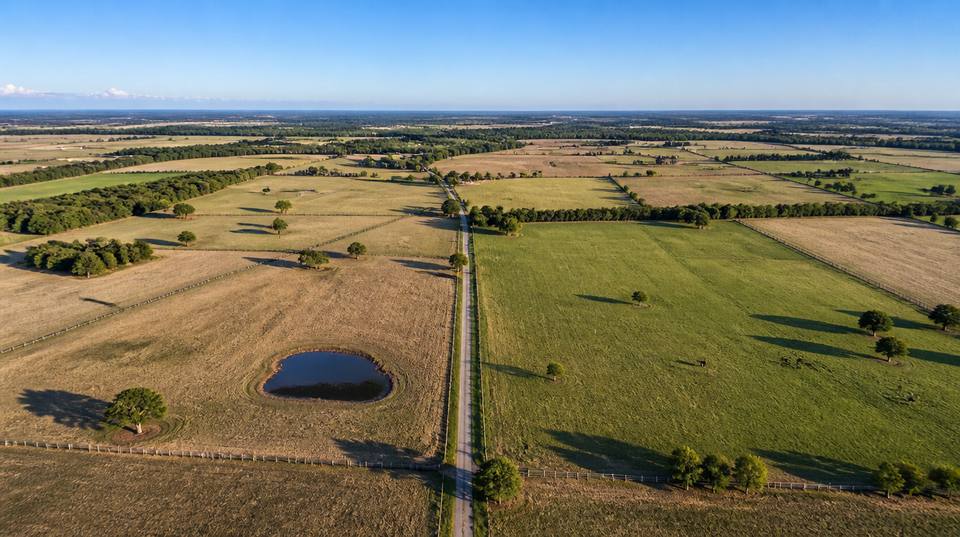
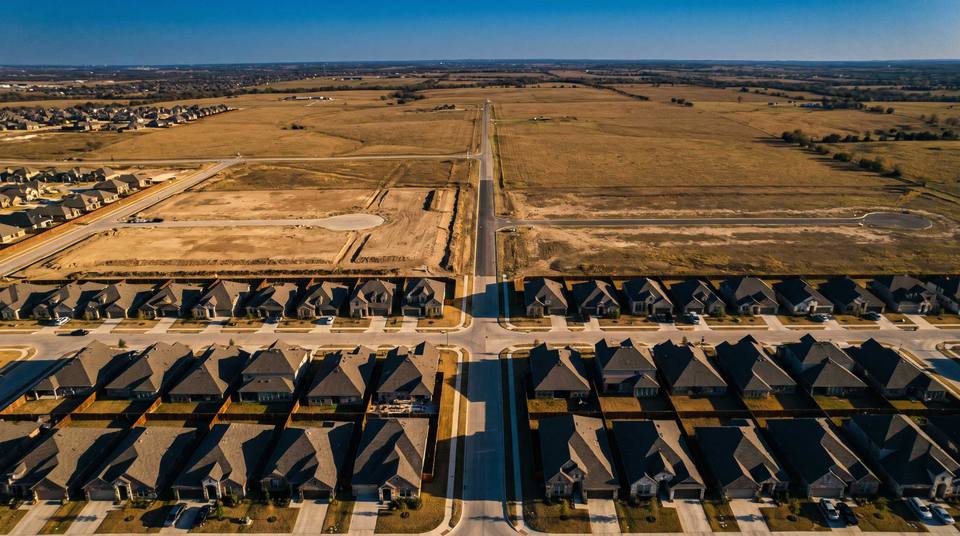
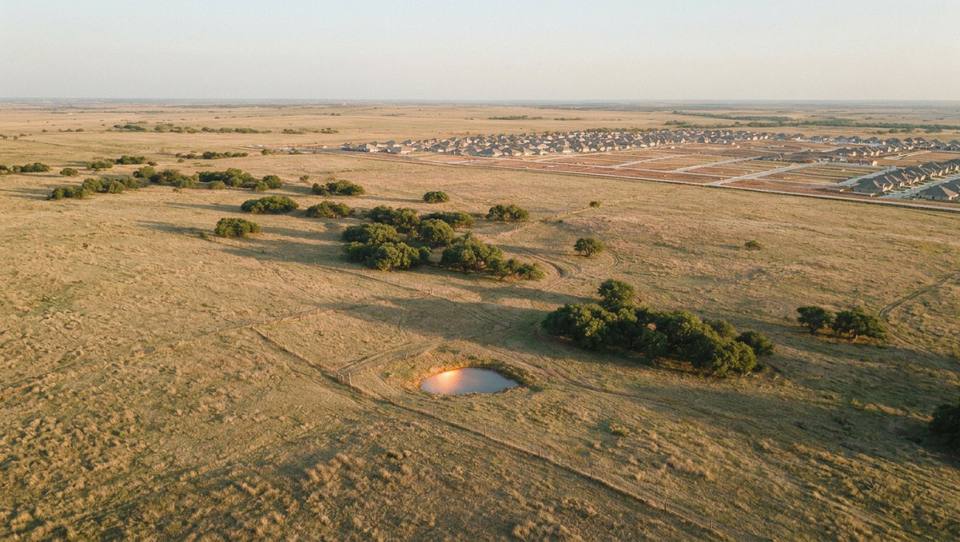
Land banking is a simple thesis executed over a long horizon. Acquire raw acreage ahead of the growth path, carry it cheaply under agricultural valuation, and sell once to a developer or homebuilder when the path arrives. Along the Dallas North Tollway corridor, that curve has been running for two decades and is still running.
The structure produces one enormous taxable event. Decades of appreciation land in a single closing, and without deferral a large share leaves at settlement and never compounds again.
That is the case for pairing land banking with a Texas land 1031 exchange. Rolling proceeds forward keeps the full basis working. Common landing spots for owners exiting appreciated dirt include single-tenant net lease retail, small-bay industrial, and Delaware Statutory Trust interests when the owner wants income without management.
Note the asymmetry. The passive holder who did nothing but pay taxes and wait sits in the strongest possible Texas land 1031 exchange position. That is not incidental. It is the design.
The Dealer Problem
Dealer classification is where Texas land 1031 exchange planning most often falls apart, and it is the least discussed risk in the category. If the IRS treats a landowner as a dealer, the land is inventory rather than investment property. Gain becomes ordinary income, taxed at ordinary rates, and Section 1031 is unavailable. Not reduced. Unavailable.
Courts apply no bright-line test. They weigh frequency and continuity of sales, extent of subdivision and development activity, length of the holding period, marketing effort, and purpose at both acquisition and disposition. The pattern that emerges is uncomfortable for anyone running an active land business, because the activities that build value are the same ones that erode a Texas land 1031 exchange position.
| Strategy | Profile | 1031 position | Why |
|---|---|---|---|
| Passive long hold | Acquire and hold raw acreage for years or decades, minimal improvement, one sale to a developer | Strongest | Clear investment intent, no sales activity, no subdivision. Textbook qualifying property. |
| Assemble and deliver shovel-ready | Aggregate parcels, secure entitlements and utilities, sell to developers | Mixed | Repeated sales of improved parcels begin to resemble a trade or business. Facts-and-circumstances territory. |
| Rapid entitle and flip | Short holds, subdivide, improve, sell repeatedly | Weakest to none | Dealer classification likely. Land becomes inventory, gain is ordinary income, deferral unavailable. |
Real transactions illustrate the spectrum. On the passive end sits the Lake Austin hilltop Exxon held roughly 25 years under layered LLC ownership before Jonathan Coon acquired it, added 60 adjacent acres, and closed an $870 million construction loan in August 2026 for 229 residences across 210 acres. In the middle, Partners Capital assembled 189 acres in North Houston through Land Fund 1 beginning in 2022, then delivered the site shovel-ready for Portman's 714,233-square-foot Gateway 1960 industrial park. On the active end, Hillwood is marketing roughly 150 acres in east Austin, about 118 of them entitled for a 1.4 million-square-foot industrial master plan.
Each created value. They did not create it the same way, and the tax treatment follows the method.
Where a Texas Land 1031 Exchange Actually Fails
Four failure points, in rough order of frequency.
The clock versus land due diligence. Closing on the relinquished property starts two periods. Forty-five days to formally identify replacement property, and 180 days to close on it. They run concurrently from the same date, so the 180 days is not 180 days after the 45. Land buyers accustomed to 90-day feasibility periods find 45 days brutally short, which is why tenancy-in-common interests and Delaware Statutory Trusts get used as identification backstops.
The partnership and LLC trap. Membership and partnership interests are not like-kind property. A family LLC holding a ranch cannot exchange its units. Only the entity can exchange, and only if every partner agrees on the same replacement. When one sibling wants cash and another wants deferral, the common fix is a drop and swap: distribute tenancy-in-common interests to the partners before the sale so each acts independently. Executed too close to closing, the held-for-investment requirement becomes contestable.
Dealer classification. Covered above, and the one Texas land 1031 exchange failure that cannot be repaired at the closing table.
Ag rollback nobody modeled. Separate from any Texas land 1031 exchange, and routinely conflated with it.
Reverse and improvement exchanges solve part of the timing problem. Under the safe harbor in Revenue Procedure 2000-37, an Exchange Accommodation Titleholder parks title, usually to the replacement property, for up to 180 days so the taxpayer never holds both at once. Improvement exchanges let exchange funds pay for construction while the titleholder holds title, though the work must finish inside the 180-day window to count toward replacement value. The safe harbor is optional. Structures outside it carry materially more risk.
One myth is worth killing. No statutory holding period governs land. Articles citing a hard two-year rule are misreading Section 1031(f), which addresses exchanges between related parties. Qualification turns on intent and facts, not on a calendar.
The Texas-Specific Math
Texas has no state income tax, so deferral through a Texas land 1031 exchange is purely a federal question. That is cleaner than California, where the state tracks deferred gain moved into out-of-state replacement property and claws it back on sale. Texas owners model one set of rules.
Ag rollback is the line item that surprises people, and where most published guidance is out of date. Owners carrying land under agricultural valuation should model this separately from the federal analysis.
Change of use on open-space appraised land triggers a rollback covering the previous three tax years. House Bill 1743, effective September 1, 2019, cut that period from five years to three and reduced interest from 7 percent to 5 percent. House Bill 3833 then removed the interest provision entirely for Subchapter D agricultural land, effective June 15, 2021, for changes of use occurring on or after that date. Interest now applies only if the rollback taxes themselves become delinquent. Land appraised under Subchapter C, the 1-d valuation, still incurs interest on change of use or sale.
Most competing articles still report three years plus 5 percent interest, or worse, five years plus 7 percent. Underwriting a hold-to-develop deal on stale figures overstates the exposure.
Two facts govern the rest. Buying land does not trigger rollback. Changing the use does. Other triggers include subdividing below minimum acreage, failing county intensity standards, and missing filing deadlines. Land carried under a wildlife management valuation faces the same rollback exposure on change of use.
A Texas land 1031 exchange does nothing about any of this. Rollback is a county property tax. Deferral is federal. The two travel on separate tracks, and conflating them produces underwriting errors in both directions.
Swap Till You Drop
The estate angle moves this from tax maneuver to generational strategy.
Deferred gain carries forward in adjusted basis indefinitely. Exchange into net lease retail, again into industrial, again into a Delaware Statutory Trust. Each Texas land 1031 exchange pushes the liability forward rather than settling it. Hold the final property until death and heirs generally receive a stepped-up basis at fair market value. The deferred gain is eliminated, not merely postponed.
For a Texas family holding the same section across three generations, that reframes the decision. The question stops being whether to sell and becomes how to convert appreciated dirt into income-producing assets without a taxable event, then pass those assets with clean basis.
Frequently Asked Questions
Can you 1031 exchange raw land in Texas?
Yes. Raw land held for investment qualifies as real property under Section 1031, and a Texas land 1031 exchange follows the same federal rules as any other real estate exchange. Qualification depends on holding purpose. Land acquired primarily for resale does not qualify, regardless of acreage.
Is there a required holding period before land qualifies for a 1031 exchange?
No statutory holding period governs a Texas land 1031 exchange. The commonly cited two-year figure comes from the related-party rule in Section 1031(f), a different provision. Qualification turns on demonstrated investment intent and surrounding facts. Longer holds build stronger records, but no calendar threshold guarantees the treatment.
What happens if the IRS classifies a land investor as a dealer?
The land becomes inventory rather than investment property. Gain is taxed as ordinary income, and a Texas land 1031 exchange is no longer available on that parcel. Courts weigh sales frequency, subdivision and development activity, holding period, marketing effort, and purpose at acquisition and disposition.
Can you buy the replacement property before selling your land?
Yes, through a reverse Texas land 1031 exchange under the safe harbor in Revenue Procedure 2000-37. An Exchange Accommodation Titleholder parks title for up to 180 days so the taxpayer does not hold both properties simultaneously. Reverse exchanges cost more and require financing arranged in advance.
Can partners in an LLC do separate 1031 exchanges on the same ranch?
Not directly. Partnership and LLC interests are not like-kind property. The common workaround distributes tenancy-in-common interests to individual partners before the sale, letting each run a separate Texas land 1031 exchange or cash out. Timing is the exposure, since interests distributed immediately before closing invite challenge.
Does a Texas land 1031 exchange avoid Texas ag rollback taxes?
No. Rollback is a county property tax triggered by change of use on agriculturally appraised land. A Texas land 1031 exchange defers federal capital gains tax. The two are entirely separate, and landowners routinely conflate them when modeling a sale.
What happens to deferred gain when the owner dies?
Deferred gain carries forward in adjusted basis through each successive exchange. If the owner holds the final replacement property until death, heirs generally receive a stepped-up basis at fair market value, and the deferred gain is eliminated rather than inherited.
Structure Comes Before Contract
The uncomfortable conclusion is that a Texas land 1031 exchange rewards the owner who did the least. Passive holds qualify cleanly. Active entitlement operations, the ones producing the highest returns per year of ownership, trade that treatment away for velocity. Neither approach is wrong. They are different businesses carrying different tax profiles, and mistaking one for the other at closing is expensive.
Timing is not negotiable. Ownership structure, entity questions, and dealer exposure have to be resolved before the property goes under contract. A qualified intermediary must be engaged before closing, because touching the proceeds ends the exchange. Once the deed records, the options are gone.
Underwrite the exit structure before the tract goes to market, not after an offer lands. Request a Land Banking Exit Brief for a parcel-level read on holding profile, dealer exposure, and ag rollback position across the eight-county North Texas footprint.
References
- 26 U.S.C. Section 1031, Exchange of Real Property Held for Productive Use or Investment Cited for: the statutory basis for deferral, the held-for-investment requirement, and the related-party rule at Section 1031(f).
- Like-Kind Exchanges: Real Estate Tax Tips, Internal Revenue Service Cited for: deferral rather than forgiveness, the Tax Cuts and Jobs Act limiting Section 1031 to real property effective January 1, 2018, and the exclusion of real property held primarily for sale.
- Agricultural, Timberland and Wildlife Management Use Special Appraisal, Texas Comptroller of Public Accounts Cited for: open-space appraisal eligibility under Tax Code Chapter 23, Subchapters C and D, and the Comptroller's adopted Manual for the Appraisal of Agricultural Land.
- 2021-22 Texas Statutes Summarized and Explained, Texas Real Estate Research Center Cited for: House Bill 3833 removing interest from the rollback tax imposed on change of use under Texas Tax Code Sections 23.55 and 23.76.
- House Bill 3833 Senate Research Center Bill Analysis, 87th Texas Legislature Cited for: stated legislative intent to eliminate interest due on rollback taxes, and the amendments to Texas Tax Code Section 23.55 subsections (a), (b), (e), (f), (m), and (n).
- Tax Code Changes You Can Use Today: Rollback Taxes, Gray Winston Cited for: the June 15, 2021 effective date of the Subchapter D interest repeal, applying only to a change of use occurring on or after that date.