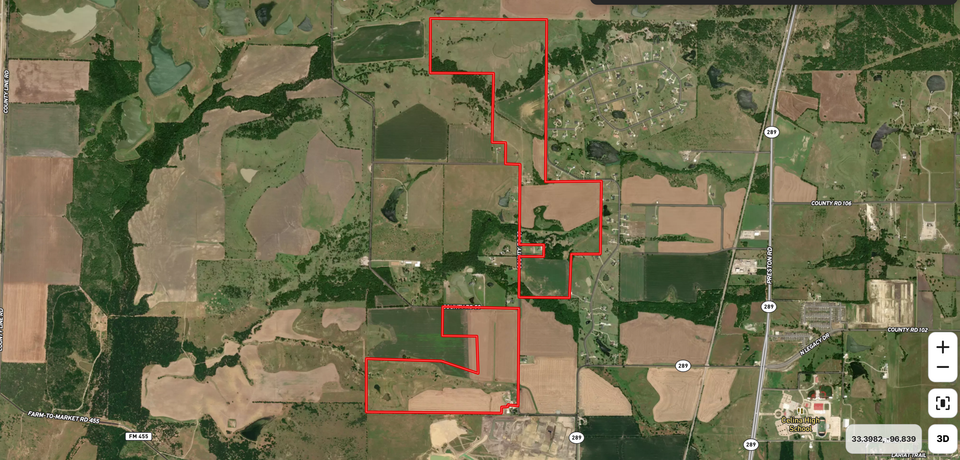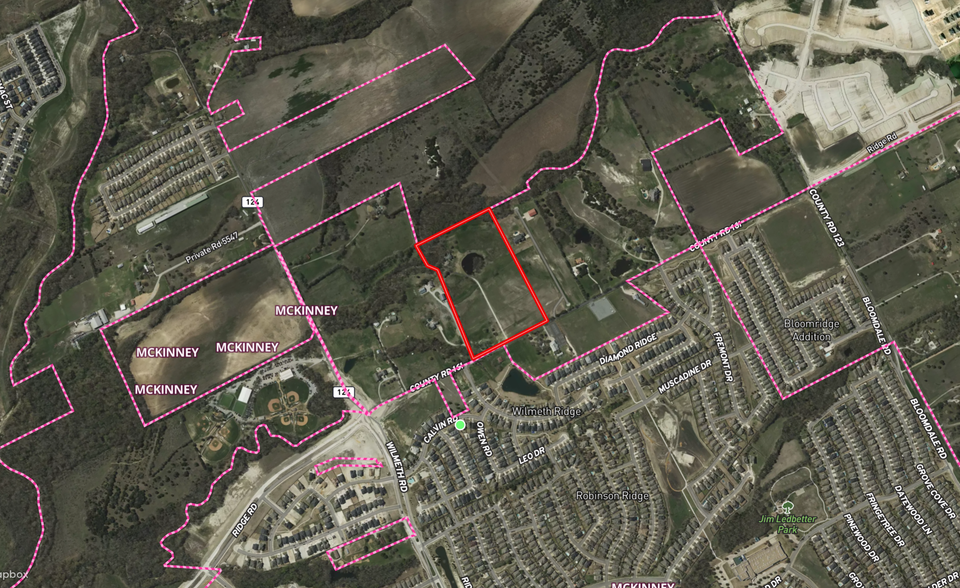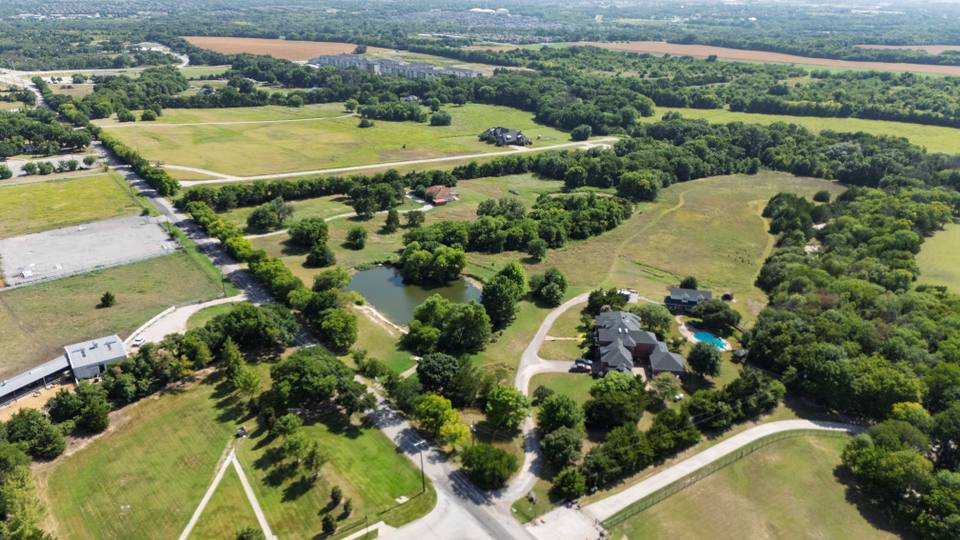
For eight years we have driven by the very land that is about to become apartments.
Many times we have had to stop in the middle of the road to the let the the baby ducks and geese walk across the road...yes even though it is McKinney, there is still wildlife around...not to mention the runway and helopad
Not a metaphor. There is a runway on the 37 acres across County Road 161 from my house, with a helicopter pad and a hangar. When we moved in, this was Collin County. Open country, large lots, a two-lane blacktop with the edges crumbling into the bar ditch.
On March 17, 2026, the McKinney City Council annexed that land and approved MF36 zoning on it. The hearing ran about seven minutes. Nobody spoke. The vote was five to one. Somewhere between 550 and 600 apartments are going in across the street.
I sell land for a living. I am not going to stand on my porch and act shocked that a corridor near a planned US 380 bypass attracted a developer. That is not the story. The story is what the file says, and what it does not.
The road is the part that keeps me up
County Road 161 is one lane in each direction. It is asphalt and it is in poor shape. At the hearing the applicant's representative called it a mess with sloughing edges, and he was being generous.
The developer will improve it, and that is real. Roughly 1,530 linear feet of frontage gets widened, the surface goes from asphalt to concrete, an eight-foot sidewalk goes in, and turn lanes get added at the entrances.
Here is the part that took me two readings to catch. Ridge Road from Wilmeth to Bloomdale is designated on McKinney's master thoroughfare plan as a four-lane divided roadway. This project builds two of those four lanes. The applicant said so at the podium, describing it as a first phase passable in two directions.
So the corridor gets 600 units of new demand and half a road. The other two lanes are on a plan, and plans are not funded construction schedules. Nothing in this case file says who builds the rest, or when.
Then there is Fremont Drive
Fremont Drive is my street.
In the applicant's letter of intent, filed by Winstead PC in January 2025, two right-hand deceleration lanes are described along the frontage. One of them is designated to serve as a future extension of Fremont Drive.
Read that the way a land professional reads it. The plan anticipates Fremont Drive eventually cutting into that tract. What gets built now is a turn lane. What the turn lane holds a place for is a through connection.
I do not know the timing. Neither does the case file. But the geometry is being poured in concrete, and geometry is patient.
What MF36 zoning actually permits
This is the single most important thing in the file.
MF36 is McKinney's multi-family residential district. Under the city's Unified Development Code it allows up to 36 dwelling units per acre. The tract is 37.4063 acres. At the district maximum, MF36 zoning permits roughly 1,346 units.
The applicant told council the project would be 550 to 600 units. The letter of intent describes about 14 units per acre and says the developer intends to commit to a maximum of 16. Sixteen per acre across this tract produces about 600. That is where the number comes from.
But that commitment does not live in the zoning ordinance. It lives in a development agreement the letter repeatedly calls forthcoming. The verbs are conditional throughout. The developer intends to commit to the density cap, is willing to commit to the amenities and timing, and routes unit sizes and finishes to the same future document.
| What we were told | Where it binds |
|---|---|
| 550 to 600 units | Development agreement, if executed |
| 16 units per acre maximum | Development agreement, if executed |
| Amenities, unit sizes, finishes | Development agreement, if executed |
| 36 units per acre | The zoning ordinance |
Zoning runs with the land. Concept plans do not. If that tract sells before anything vertical goes up, and entitled land trades all the time, the next owner buys the district. Not the pitch. Not the rendering of the pool deck. The district.
The decision that made the ceiling possible
On page six of the letter of intent, the applicant states that MF36 straight zoning was requested based on prior feedback from city planning staff indicating a preference for straight zoning over a Planned Development district.
A PD is the tool that locks conditions into the ordinance itself. Density caps, height, buffers, architectural standards, phasing. Straight zoning applies the base district and nothing else.
I am not alleging anything improper. Staff has legitimate reasons to prefer straight zoning. But the consequence is that the enforceable number on the land across from my house is 36 units per acre, and everything below it sits in a contract I have not seen.
Why it passed in seven minutes
Planning Manager Strickland spoke for about ninety seconds. She said staff was supportive, then said the request does not align with the comprehensive plan, and that staff reviewed it against city criteria and found it appropriate anyway. Not one council member asked a follow-up question. The tract was mapped as a Suburban Living placetype in the One McKinney 2040 plan, which contemplates detached single-family housing. That is what the map said when we bought our house.
The applicant's representative, Bob Roeder, barely argued the project. He argued leverage. Texas cities cannot involuntarily annex. In the ETJ, he noted, the city has no zoning control, and the property could develop as multifamily anyway without city safeguards. His pitch was that this was the city's chance to get the land inside the limits, collect the tax revenue, and gain authority it does not otherwise have.
That argument is only getting stronger. Cities lost involuntary annexation power in the 2017 and 2019 sessions. Then Senate Bill 840 took effect September 1, 2025, requiring cities over 150,000 in counties over 300,000 to allow multifamily by right in any district permitting office, commercial, retail, or warehouse use, and barring them from imposing density below the greater of 36 units per acre or the highest density allowed anywhere in the city.
McKinney's standard multifamily district permits 36 units per acre. The state floor is 36 units per acre. The city's number predates the bill, so I am not claiming cause and effect. But the density a council can defend and the density the state guarantees have converged.
When a neighbor asks why nobody stopped this, the honest answer is that the tools people assume exist have been coming apart for nine years. A comprehensive plan is a planning document. A placetype map describes intent. Neither is a property right.
What the city got in the trade
The exchange was made explicit at the hearing. A council member asked whether roughly 16 acres of parkland dedication was accurate. Roeder confirmed it. The follow-up landed the point: in the ETJ, these owners would dedicate zero parkland and pay zero park enhancement fees.
Annexation also obligates the developer to:
- Build the concrete frontage widening, sidewalk, and turn lanes at its own expense
- Extend about 920 linear feet of 12-inch water line and upsize about 1,490 feet from 8-inch to 12-inch, both already on the city's Capital Improvements Plan
- Preserve roughly 13 acres of open space including floodplain, two ponds, and more than a mile of trails
Left in the county, none of that happens. Worth noting: the letter says the water upsizing could spur further development south along CR 161. That is the applicant's own language, and anyone who owns acreage down this road should read it twice.
What this means if you own land out here
I make money when land in this corridor moves. If I complained that development reached my address after years of helping it reach other people's, I would be a hypocrite with a blog. So to be precise: I do not object to 600 apartments across the street. I object to a two-lane road carrying them, a through-street extension buried in a turn-lane description, and an enforceable ceiling more than twice the number said out loud at the microphone.
- Your entitlement is the asset. Your site plan is marketing. A buyer purchases the district.
- Straight zoning and PD zoning are different instruments. Know which is on the table and what it locks down.
- The development agreement is where the real deal lives. Ask whether it has been executed, then read it.
- Show up. Seven minutes and zero speakers is not a conspiracy. It is an empty room. I was watching this case and I did not go to the podium either.
Questions I get at the mailbox
What does MF36 zoning mean?
It is McKinney's multi-family residential district. The Unified Development Code permits up to 36 dwelling units per acre. Applied as straight zoning, base district standards govern unless a Planned Development overlay adds conditions.
How many apartments can legally be built on the CR 161 tract?
The MF36 zoning permits roughly 1,346 units at the district maximum across 37.4063 acres. The applicant described 550 to 600 units and an intent to commit to 16 units per acre in a separate development agreement.
Why did the property have to be annexed?
It sat in McKinney's extraterritorial jurisdiction, where the city has no zoning authority. Texas cities lost involuntary annexation power in the 2017 and 2019 sessions, so the owners petitioned voluntarily. The annexation and the zoning were interdependent.
The bottom line
Eight years ago this was county land with an airstrip on it. In seven minutes it became a McKinney MF36 zoning district with legal capacity for more than 1,300 apartments, in exchange for two lanes of concrete, a water main, and about 16 acres of parkland.
Every step followed the code. That is exactly why it is worth understanding rather than resenting. The enforceable terms sit in a two-letter, two-digit district label, not in any rendering.
I am not moving. I will watch them pour the concrete from my front yard and keep pulling the case files, because the next 37 acres on this road is already in front of the council.
If you own land in the path of this, the lesson is not that apartments are coming. It is that the document deciding your outcome is far shorter and blunter than you think.
The author is a McKinney-based REALTOR® that specializes in land and lives directly across County Road 161 from the subject tract. Every fact in this article comes from the City of McKinney public record, including the March 17, 2026 council meeting transcript and the applicant's letter of intent filed in case 24-0104Z.
Sources and public records
Every factual claim in this article comes from the documents below. Primary records are listed first. Where a figure appears only in secondary coverage, that source is identified.
City of McKinney public record
- City of McKinney, City Council Regular Meeting, March 17, 2026, video and transcript. The annexation and MF36 zoning item begins at approximately the 35:38 mark. Source for the five to one vote, the absence of public comment, planning staff's comprehensive plan statement, the applicant's roadway and annexation remarks, the unit count and bedroom mix, the parkland exchange, and the school generation estimate.
- Winstead PC, Letter of Intent, application to zone 37.4063 acres to MF36, filed January 15, 2025. Source for the tract size and addresses, ownership, the private runway and helicopter hangar, the straight zoning request and staff preference, the density figures and development agreement language, the open space and floodplain acreage, the water line and roadway specifications, and the Fremont Drive extension.
- City of McKinney, Legistar file 24-0104Z, request to zone the subject property to MF36 Multi-Family Residential District. Companion annexation case is 24-0004A.
- City of McKinney, Unified Development Code. Governing document for the MF36 district standards.
- City of McKinney, Development Reports. Monthly and annual permit and development activity, used to track the tract from entitlement into construction.
Texas state law
- Haynes Boone, Texas Senate Bill 840: By-Right Multifamily Development Now in Effect. Source for SB 840's effective date, population thresholds, and by-right approval pathway.
- Foley & Lardner LLP, Client Briefing: Texas Senate Bill 840 and Texas Senate Bill 2477, 89th Legislature. Source for the statutory density floor of the greater of 36 units per acre or the highest residential density allowed in the city.
- Texas Municipal League, Legislative Update, August 29, 2025. Municipal summary of SB 840 obligations and administrative approval requirements.
- Multifamily Dive, New Texas law allows apartments in some nonresidential zones. Signing date and scope.
News coverage
- Community Impact, Multifamily zoning case heads to McKinney City Council, May 13, 2026. Source for the MF36 district permitting up to 36 units per acre under McKinney's Unified Development Code, and for city planning staff's on-record statement regarding by-right multifamily development under SB 840. Reported on a separate McKinney case.
- Community Impact, Council approves annexation, zoning for new apartments in north McKinney, March 18, 2026.
- Community Impact, Recommendation for zoning change could bring new McKinney apartment community, February 25, 2026. Planning and Zoning Commission stage.
A note on what is not here
The development agreement referenced throughout the applicant's letter of intent was not located in the public case file at the time of writing. The traffic impact analysis was completed and reviewed by the city but was not quoted at the March 17 hearing and is not linked above. Both documents are available by request from the City of McKinney Planning Department or City Secretary, and both would sharpen several of the questions raised in this article.