Table of Contents
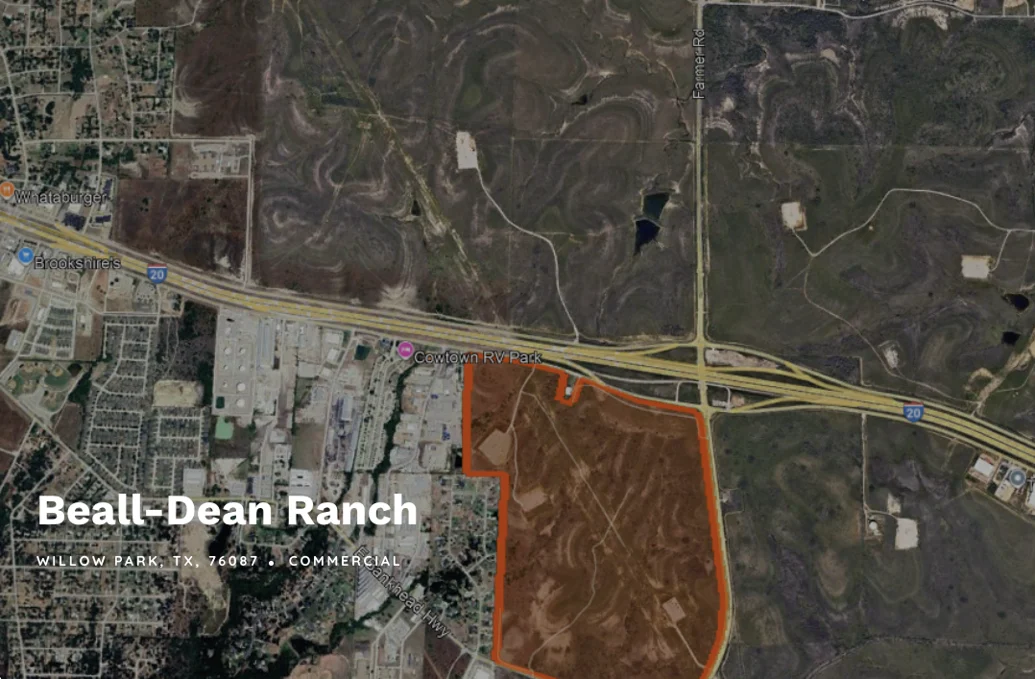
The Willow Park annexation lawsuit filed by Fort Worth and Aledo could halt a $500 million mixed-use project on the western edge of the Dallas-Fort Worth metroplex. At stake is the 317.732-acre Beall-Dean Ranch development at the southwest corner of Interstate 20 and FM 1187, plus a 10.98-acre stretch of Bankhead Highway right-of-way that prosecutors call the linchpin of an unlawful land grab. A Parker County district judge is set to hear arguments on a temporary restraining order in May 2026.
The case is City of Aledo and City of Fort Worth v. City of Willow Park, Cause No. CV26-0175, filed February 9, 2026, in the 43rd Judicial District Court. Judge Craig Towson will decide whether Willow Park’s 2024 and 2025 annexation ordinances stand or get voided. For Texas land professionals, the outcome will reshape how jurisdictional risk gets priced into fringe-of-ETJ deals across the state.
What the Willow Park Annexation Lawsuit Actually Alleges
The legal fight centers on a sequence of ordinances passed by the Willow Park City Council. On November 12, 2024, the council passed Ordinance No. 914-24, which expanded the city’s extraterritorial jurisdiction (ETJ) to encompass roughly 321 acres owned by Beall-Dean Ranch, Ltd. That same meeting authorized a development agreement, accepted a voluntary annexation petition, initiated a Public Improvement District, and approved $5,135,000 in Certificates of Obligation for water and wastewater infrastructure.
Three months later, on February 11, 2025, the council passed two more ordinances. Ordinance No. 917-25 annexed a 10.98-acre strip of Bankhead Highway right-of-way, roughly 7,313 feet of road stretching from just west of Nu Energy Drive to FM 1187. Ordinance No. 918-25 annexed the full 317.732 acres of the ranch.
Aledo and Fort Worth argue the order of operations was legally backwards. Under Texas Local Government Code § 42.022(b), a city can only expand its ETJ to include territory contiguous to its existing boundaries. Under § 43.014, a city can only annex property already within its lawful ETJ. The plaintiffs contend Willow Park failed both tests because the Beall-Dean Ranch property was not contiguous to Willow Park when the ETJ expansion passed. The road corridor that would create physical contiguity was not annexed until three months later.
The plaintiffs argue you cannot expand jurisdiction to reach a property and then retroactively build a road corridor to justify the reach.
Why the Bankhead Highway Right-of-Way Matters
The 10.98-acre Bankhead Highway annexation is the technical center of gravity in the Willow Park annexation lawsuit. The plaintiffs make two arguments about that strip of road.
First, the corridor sat within the ETJ of two other municipalities when Willow Park annexed it. The northern portion was inside Fort Worth’s ETJ. The southern portion was inside Aledo’s ETJ and corporate city limits. Under § 42.022(c), a city cannot expand its ETJ into another city’s existing jurisdiction. The Texas Supreme Court has previously held that annexations violating this rule are void.
Second, Aledo had pre-existing infrastructure investment in the area. The city built an 8-inch water line up to the southern edge of the Bankhead Highway right-of-way in 2018 as part of its Champions Business Park. Aledo also held a development agreement with Levens Capital Partners for the Dean Ranch property dating to June 2022. The plaintiffs argue Willow Park’s later annexation effectively overran Aledo’s pre-existing claim.
Willow Park has filed a general denial. Beall-Dean Ranch, Ltd., represented by Winstead PC, has intervened in the case on Willow Park’s side. Mediation efforts last month failed to produce a resolution.
The SB 2038 Context Behind the Willow Park Annexation Lawsuit
The dispute cannot be understood without Senate Bill 2038, the 2023 Texas law often called the “ETJ Opt-Out Bill.” SB 2038 lets landowners unilaterally remove their property from a city’s ETJ through petition or election, with cities required to release the property within roughly 45 days of a valid petition.
Before SB 2038, cities held the leverage. They controlled subdivision approvals, plat regulations, and consent rights for municipal utility districts in their ETJs. Developers had to negotiate. After SB 2038, that leverage flipped. Landowners can now exit one city’s ETJ and shop their property to a neighboring municipality offering better infrastructure terms.
That is what happened with Beall-Dean Ranch. Beall has stated publicly that the choice to align with Willow Park came down to speed and access to utilities. The SB 2038 release removed Fort Worth’s ETJ overlay from the property. The plaintiffs argue, however, that the release did not eliminate Aledo’s separate, pre-existing ETJ claim, which exists by operation of law based on Aledo’s population-based one-mile radius under LGC § 42.021.
If the court agrees, the Willow Park annexation lawsuit will establish that SB 2038 cannot be used to overrun overlapping ETJ claims from multiple cities. That ruling would force developers and the cities competing for them to do far more diligence on ETJ boundaries before committing capital.
Financial Exposure for Willow Park
Willow Park is not waiting on the court. The City Council is poised to vote on a $4.1 million contract for the next phase of water and sewer infrastructure tied to the development. That commitment comes on top of the $5.135 million in Certificates of Obligation already issued for Phase 1 utilities.
The financial structure built around the development is also exposed. The development agreement contemplated a Public Improvement District (PID) and a Tax Increment Reinvestment Zone (TIRZ). Both instruments depend on Willow Park having valid municipal jurisdiction over the assessed property. If the annexation gets voided, the PID and TIRZ fail with it. A 20-year interlocal agreement with Parker County ESD No. 1 allocating sales tax revenue from the annexed territory would also need to be unwound.
For a city of Willow Park’s size, an adverse ruling means stranded debt, unwound contracts, and potential repair costs on infrastructure built outside its lawful boundaries. One resident speaking at a recent council meeting noted that Willow Park has never won an annexation dispute with a neighboring city.
What This Means for Texas Land Investors
The Willow Park annexation lawsuit is a preview of disputes coming to every fast-growth corridor in Texas. Three implications stand out for land professionals.
Jurisdictional risk is now an underwriting factor. SB 2038 made ETJ exits easy. It did not make ETJ boundaries clean. Properties on the edge of multiple cities’ ETJs carry real legal risk if the eventual annexing city does not have a clean path to contiguity and ETJ authority. Investors should request title work that includes ETJ boundary verification, not just deed history.
City shopping has a ceiling. Developers can leverage SB 2038 to negotiate, but the practice has limits when multiple cities have overlapping or adjacent claims. Cities with pre-existing infrastructure investment and development agreements have stronger legal standing than cities racing to capture new tax base.
Infrastructure speed wins, but only with legal cover. Willow Park moved faster than Fort Worth or Aledo could match. That speed is what attracted Beall to the deal. Speed without statutory compliance, however, creates litigation exposure that can erase the timeline advantage entirely.
The same dynamic shows up in other Texas land segments where infrastructure access drives valuation. The Texas data center pipeline has triggered similar competition between municipalities racing to land hyperscale tenants, and the cities winning those deals are the ones with clean jurisdiction and ready utilities. For investors and developers working the I-20, US 380, and other high-growth corridors, the lesson is operational. The cities that will win the next wave of large-tract development are the ones that can move quickly and stay inside the lines of Chapter 42 and Chapter 43 of the Local Government Code.
What is the Willow Park annexation lawsuit?
The Willow Park annexation lawsuit is a case filed by the cities of Fort Worth and Aledo on February 9, 2026, in the 43rd Judicial District Court of Parker County. The plaintiffs allege that Willow Park unlawfully annexed 317.732 acres of the Beall-Dean Ranch property and 10.98 acres of Bankhead Highway right-of-way in violation of Texas Local Government Code §§ 42.022 and 43.014.
What is the Beall-Dean Ranch development?
Beall-Dean Ranch is a planned $500 million mixed-use development on roughly 318 acres at the southwest corner of Interstate 20 and FM 1187 in Parker County. The project is part of the historic 2,000-acre Dean Ranch and includes single-family and multifamily housing, commercial space, and light industrial uses.
How does SB 2038 relate to this case?
Senate Bill 2038, effective September 1, 2023, lets landowners exit a city’s ETJ through petition or election. Beall-Dean Ranch used SB 2038 to leave Fort Worth’s ETJ. Plaintiffs argue, however, that the release did not eliminate Aledo’s separate ETJ claim and that Willow Park’s subsequent annexation violated state law.
When will the court rule?
Judge Craig Towson is scheduled to hear arguments in May 2026 on whether to grant a temporary restraining order and broader injunctions. A ruling on the underlying annexation could take longer.
Track the Texas Land Cases That Move Markets
Jurisdictional disputes like the Willow Park annexation lawsuit reshape land values in real time. Subscribe to the North 40 Land Group Market Intelligence Brief for case-by-case analysis of Texas annexation, ETJ, and infrastructure rulings that affect investor underwriting.
References
- Yahoo News / Weatherford Democrat. “Aledo, Fort Worth sue Willow Park over city’s annexation off Farm-to-Market 1187.” March 1, 2026. https://www.yahoo.com/news/articles/aledo-fort-worth-sue-willow-045900888.html
- The Real Deal. “$500M Dean Ranch project caught in deepening annexation battle.” April 13, 2026. https://therealdeal.com/texas/2026/04/13/500m-dean-ranch-project-caught-in-annexation-fight/
- The Citizen. “Update: The Beall Dean Development Lawsuit.” March 2, 2026. https://thecitizentexas.substack.com/p/update-the-beall-dean-development
- Fort Worth Report. “Regional land fight: Fort Worth expected to join annexation lawsuit against Willow Park.” January 28, 2026. https://fortworthreport.org/2026/01/28/regional-land-fight-fort-worth-expected-to-join-annexation-lawsuit-against-willow-park/
- Weatherford News. “Growing by Metes and Bounds.” March 27, 2026. https://www.weatherford-news.com/stories/growing-by-metes-and-bounds,161879
- Texas Municipal League. “Post-Session Update: ETJ Release (SB 2038).” https://www.tml.org/DocumentCenter/View/4129/Summary-of-SB-2038-Appendix-B
- Beall Investments. “Beall-Dean Ranch project page.” https://beallinvest.com/project/beall-dean-ranch