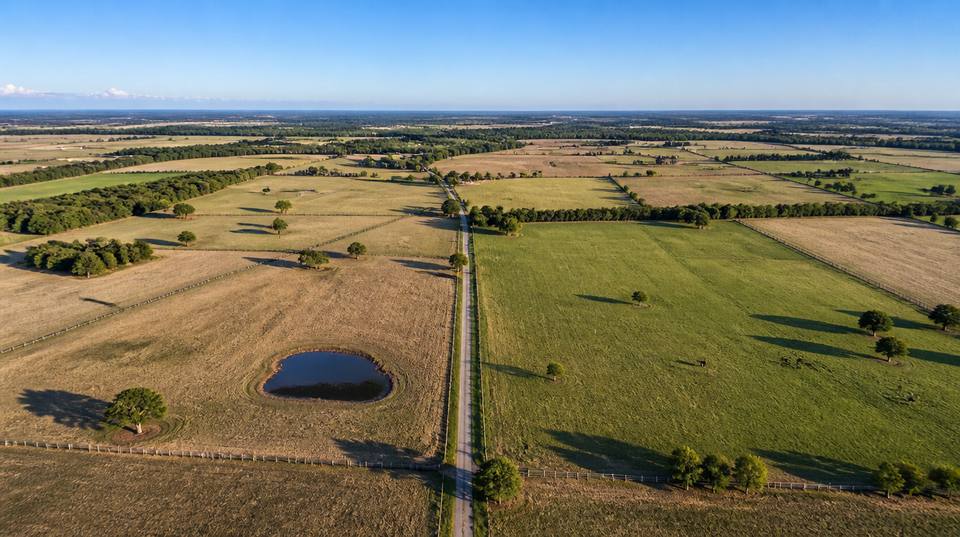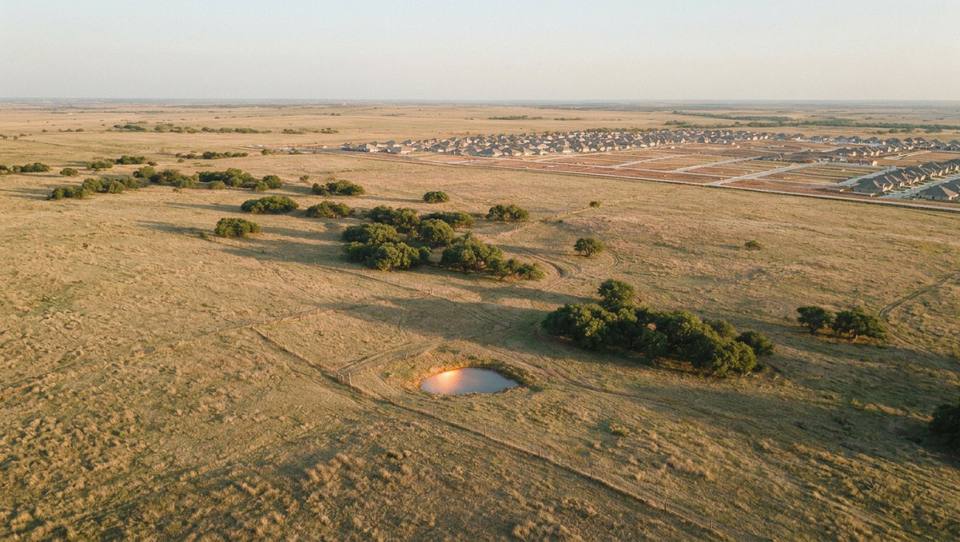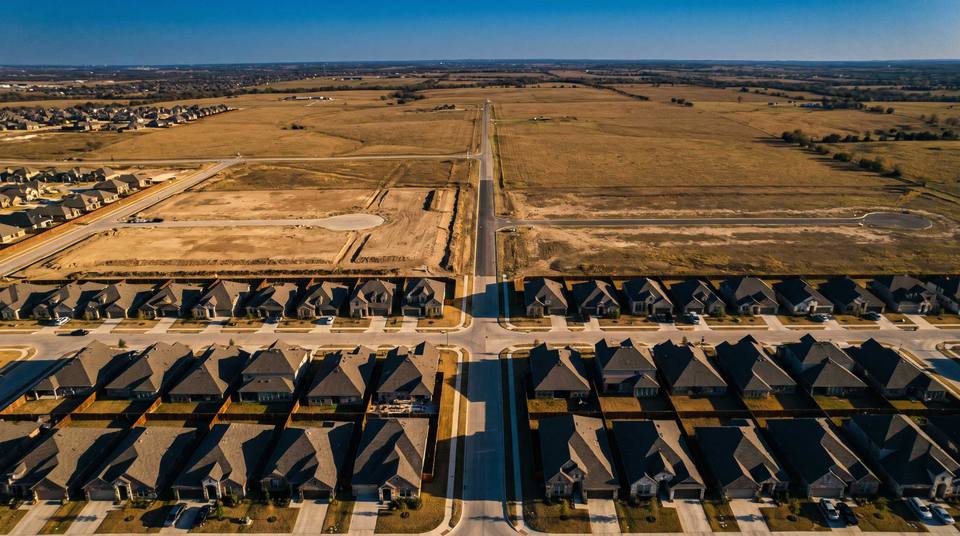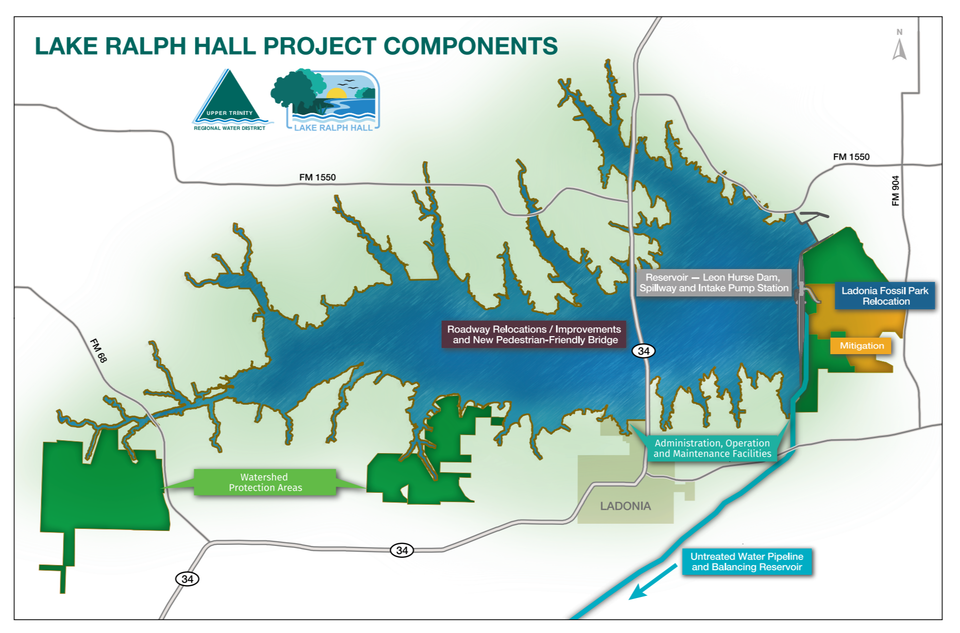
Water started backing up behind the dam in early July. After more than three decades of planning and five years of construction, Lake Ralph Hall is filling on the North Sulphur River in southeast Fannin County, roughly two miles from Ladonia.
It is the second major reservoir built in Fannin County in four years. The first was Bois d'Arc Lake, roughly 30 miles northwest near Bonham, which the North Texas Municipal Water District dedicated in October 2022 as the first major reservoir Texas had built in over 30 years.
That is not trivia. It means the question every Fannin County landowner is asking about Lake Ralph Hall already has a partial answer sitting one county road over. It also means most of the coverage is getting the delivery timeline wrong in a way that matters if you are underwriting land or a project in the growth corridor south of it.
What Lake Ralph Hall Delivers, and When
The Upper Trinity Regional Water District built the project to supply its member and customer communities across North Texas. At full build, the project provides up to 54 million gallons per day, split between 35 million gallons of raw water and 19 million gallons of reuse, according to the project.
The delivery schedule is where the confusion starts. Limited water delivery is scheduled for late 2026. That is a commissioning and testing milestone, not delivered capacity.
Community Impact reported the fuller sequence: initial delivery to Celina in late 2026, pipeline construction complete in fall 2027, and plant expansion complete in fall 2028. UTRWD could begin planning a further expansion around 2030.
Published reporting has cited three different dates for when Lake Ralph Hall comes online. April 2025 coverage put it at May 2026. Other reporting that same month cited May 2027, attributed to UTRWD through a city report. The project's own site now states limited delivery in late 2026 with full operation in 2027.
Use the project's own timeline and read the distinction carefully. Water moving through a pipe for testing is not the same as capacity a city can draw against.
Thirty Years From a Ladonia Town Hall
The origin story is worth knowing, because it tells you what a new water supply actually costs in time.
The concept behind Lake Ralph Hall started more than 30 years ago at a Ladonia town hall meeting. Mayor Leon Hurse and local civic leaders wanted a stable water supply and an economic anchor. On advice from then Congressman Ralph Hall, Ladonia sought a larger partner. In December 2004, the city and UTRWD formalized a partnership to develop a reservoir on the North Sulphur River.
The Texas Commission on Environmental Quality granted the water rights permit on December 11, 2013. The U.S. Army Corps of Engineers issued the Section 404 Clean Water Act permit in January 2020. Construction began in June 2021.
Twenty-two years from partnership to first fill. Nine years from water rights permit to water in the lake. That is the realistic clock on new surface water in Texas, and Lake Ralph Hall moved faster than most.
The financing structure is worth noting too. Costs are shared by the communities that receive UTRWD water, with help from the Texas Water Development Board's State Water Implementation Fund for Texas. No tax revenue is being used to build the reservoir.
That funding channel matters more now than it did a year ago. Texas voters approved Proposition 4 in November 2025 by more than 70 percent, dedicating up to $1 billion a year in existing sales tax revenue to the Texas Water Fund from 2027 through 2047. Lake Ralph Hall predates that money, but it shows what the state's funding programs are for and how long the resulting projects take.
What Lake Ralph Hall Means for the Celina Corridor
Celina is the clearest test case. The city buys water under a 10 million gallon per day subscription with UTRWD and has no groundwater system or second provider. Mayor Ryan Tubbs said in January that the city averages roughly 6.4 million gallons per day and has peaked at 11.8 million gallons per day.
Celina entered Stage 2 water conservation on July 2, 2026. Last year Stage 2 did not begin until August 23.
If your read of the situation is that Lake Ralph Hall solves this in 2026, adjust it. Meaningful additional volume arrives across 2027 and 2028. Celina and its neighbors face at least two more constrained summers, and any pro forma built on 2026 relief is built on a commissioning date rather than a capacity date.
There is more to this story on the Celina side, including how the city's development code interacts with its current restrictions. We have submitted written questions to the City of Celina and a Public Information Act request for the underlying records. That analysis publishes once the city responds or the deadline passes.
Bois d'Arc Lake Is the Comp, and It Is 30 Miles Away
Before speculating about what Lake Ralph Hall does to Fannin County land, look at what the last one did.
NTMWD began permitting Bois d'Arc Lake in 2003 and broke ground in May 2018. The lake began filling in spring 2021. It was dedicated in October 2022, and water deliveries started in March 2023. The finished reservoir covers roughly 26 square miles with 172 miles of shoreline and a firm yield of 82 million gallons per day.
The number that matters most for anyone watching Lake Ralph Hall is the recreation date. Bois d'Arc opened to public access on April 17, 2024, once rainfall brought levels high enough for sustained use. That is roughly three years from the start of filling to a lake the public could actually get on.
Lake Ralph Hall's own estimate is three to five years, rainfall dependent. Bois d'Arc landed at the fast end of that range. That does not guarantee a repeat, since fill rates depend entirely on precipitation and the two watersheds are not identical, but it is the most relevant precedent available and it is in the same county.
The economics carry a similar signal. Construction alone added roughly $500 million in economic activity in Fannin County. At the dedication, then County Judge Randy Moore said the county was "already seeing it drive our economy upward" and called the lake a catalyst for new growth benefiting Bonham and the surrounding area.
One caution before anyone builds a thesis on it. Public officials talking at a ribbon cutting are not a land price series. What Bois d'Arc gives you is a verified timeline and a set of decisions Fannin County has already had to make about access, shoreline management, and road capacity. Those are the things to go study, because Lake Ralph Hall will force the same set.
The Fannin County Land Question
Lake Ralph Hall is filling in a county most DFW buyers still have never driven through. Lake Ralph Hall will open for recreation once it has filled sufficiently and is safe for public use, which the project estimates at three to five years depending on rainfall. Call it 2029 to 2031, with real variance.
Be honest about the uncertainty before you act on it. There is no public access today. There is no marina, no boat ramp open to the public, and no confirmed recreational development plan in the public record that we could verify. Fill rates on a new Texas reservoir depend entirely on precipitation, and a dry stretch pushes the date right.
What is knowable is the timeline and the geography. Lake Ralph Hall sits closest to Ladonia. The site is in southeast Fannin County, well outside the DFW commuter shed, and far enough from Bois d'Arc that it opens a second and separate stretch of shoreline in a county that had none at all five years ago.
For anyone holding or hunting acreage in Fannin County, the questions to work now are straightforward:
- Where do the county road improvements go
- What does Ladonia's utility capacity look like
- Which tracts have topography that will actually front water rather than sit a mile back behind someone else's
- What does the groundwater picture look like, since Fannin sits under the Red River Groundwater Conservation District and most rural tracts out there run on wells rather than city water
Lake Ralph Hall is a water supply project first. Whether it becomes a land story depends on rainfall and on decisions Fannin County has not made yet.
Frequently Asked Questions
Where is Lake Ralph Hall?
On the North Sulphur River in southeast Fannin County, Texas, near the city of Ladonia. It is owned and operated by the Upper Trinity Regional Water District.
When will Lake Ralph Hall provide water?
Limited water delivery is scheduled for late 2026, with full operation in 2027. Pipeline construction is projected for completion in fall 2027 and a related plant expansion in fall 2028.
How much water will it supply?
Up to 54 million gallons per day at full build, consisting of 35 million gallons of raw water and 19 million gallons of reuse water.
When can the public use Lake Ralph Hall for recreation?
The project states the lake will open for recreation once it has filled sufficiently and is safe for public use, estimated at three to five years after filling begins, depending on rainfall.
Who paid for it?
The communities that receive UTRWD water, with assistance from the Texas Water Development Board's State Water Implementation Fund for Texas. No tax revenue is being used for reservoir construction.
Is Lake Ralph Hall the first new reservoir in Texas in 30 years?
No. That distinction belongs to Bois d'Arc Lake in Fannin County, which the North Texas Municipal Water District dedicated in October 2022. Lake Ralph Hall is the second major reservoir built in Fannin County in four years.
The Bottom Line
Fannin County now holds two of the newest major reservoirs in Texas, and neither one was built for Fannin County. Lake Ralph Hall arrived where the water is, not where the demand is. The supply it delivers reaches the growth corridor across 2027 and 2028, not this year. The recreational value it creates is a rainfall question with a three to five year window.
Both facts have land implications, and they run in opposite directions. South of the lake, water scarcity is still pricing risk into development timing. Around the lake, a county that had no major reservoir five years ago is about to have two.
Tracking acreage in Fannin, Grayson, or the northern Collin and Denton growth path? Request a County Water and Utility Brief from North 40 Land Group. We identify the service provider or groundwater district, confirm what capacity is actually committed, and flag the timing risk before you go under contract.
References
All sources accessed July 28, 2026. Primary sources are cited in preference to secondary coverage where both exist.
- Lake Ralph Hall. "About Lake Ralph Hall." Upper Trinity Regional Water District. lakeralphhall.com/about Cited for: 54 million gallons per day at full build, 35 raw and 19 reuse; recreation access three to five years after filling, rainfall dependent; UTRWD existing supply sources.
- Lake Ralph Hall. "Project Overview." lakeralphhall.com/about/project-overview Cited for: Ladonia town hall origin and Mayor Leon Hurse; Congressman Ralph Hall's advice to seek a partner; December 2004 Ladonia and UTRWD partnership; TCEQ water rights permit December 11, 2013; Section 404 permit from the U.S. Army Corps of Engineers; June 2021 groundbreaking; SWIFT participation and the absence of tax revenue in reservoir construction.
- Lake Ralph Hall. "Reservoir." lakeralphhall.com/project-construction/reservoir Cited for: limited water delivery scheduled for late 2026; dam embankment and pump station construction status.
- Lake Ralph Hall. "Pipeline." lakeralphhall.com/project-construction/pipeline Cited for: balancing reservoir main structure completed spring 2026, enabling system testing for limited delivery.
- Lake Ralph Hall. Project home page. lakeralphhall.com Cited for: the lake began filling in early July 2026.
- Upper Trinity Regional Water District. utrwd.com Cited for: district role as wholesale provider to member and customer communities.
- Community Impact. "Funding the flow: $269M Doe Branch wastewater plant expansion underway." March 24, 2026. View article Cited for: delivery sequence of late 2026 to Celina, fall 2027 pipeline completion, fall 2028 plant expansion, and possible 2030 planning for further expansion.
- Community Impact. "Celina limits outdoor water use amid rising temperatures." July 2, 2026. View article Cited for: Stage 2 effective July 2, 2026; prior year Stage 2 running August 23 to October 1, 2025.
- City of Celina. "Water Conservation." celina-tx.gov/1304/Water-Conservation Cited for: Stage 2 restrictions and effective date.
- City of Celina. "Stage 2 Water Conservation Measures Begin on Thursday, July 2." News release. View release Cited for: the city's stated rationale for entering Stage 2.
- Hintze, Jack. "Celina weighs stricter water rules amid rapid growth." Celina Record, Star Local Media, January 23, 2026. View article Cited for: Mayor Ryan Tubbs on average daily use of approximately 6.4 million gallons and a peak of 11.8 million gallons; no supply increase from UTRWD until Lake Ralph Hall is operational.
- Celina Record, Star Local Media. "Lake Ralph Hall to deliver water by 2026 as Celina deals with water restrictions." April 2025. View article Cited for: the May 2027 operational date attributed to UTRWD through a city report, one of three published dates for the project coming online.
- Local Profile. "Here's A Possible Solution For Celina's Water Restrictions." April 2025. View article Cited for: the May 2026 operational date, one of three published dates; Celina's 10 million gallon per day subscription with UTRWD.
- Texas Water Development Board. "State Water Implementation Fund for Texas (SWIFT)." twdb.texas.gov/financial/programs/swift Cited for: the state financing program supporting the project.
- Texas Water Development Board. "Texas Water Fund." twdb.texas.gov/financial/programs/twf Cited for: Senate Bill 7 changes to the Texas Water Fund statute and House Joint Resolution 7 placing Proposition 4 on the November 2025 ballot.
- Ballotpedia. "Texas Proposition 4, Allocate Portion of Sales Tax Revenue to Water Fund Amendment (2025)." View measure Cited for: approval of Proposition 4 on November 4, 2025; allocation of the first $1 billion in net sales tax revenue above $46.5 billion to the Texas Water Fund, expiring August 31, 2047.
- North Texas Municipal Water District. "About The Lake." Bois d'Arc Lake. boisdarclake.org/about-the-lake Cited for: Bois d'Arc Lake location in Fannin County; approximately 26 square miles; storage capacity of 367,609 acre-feet and firm yield of 82 million gallons per day; permitting begun 2003, groundbreaking May 2018, dedication October 2022, water delivery March 2023; roughly $500 million in construction-related economic activity in Fannin County.
- North Texas Municipal Water District. "Dedication Celebrates First Major Texas Lake Constructed in 30 Years." October 14, 2022. View release Cited for: Bois d'Arc Lake as the first major reservoir built in Texas in over 30 years; 16,641 acres; 172 miles of shoreline; $1.6 billion project cost; $1.477 billion in TWDB SWIFT financing.
- North Texas Municipal Water District. Newsroom, public access announcement, April 17, 2024. boisdarclake.org/newsroom Cited for: Bois d'Arc Lake opening for public access on April 17, 2024, after rainfall brought levels high enough for sustained use.
- Forney Messenger. "Dedication Celebrates Completion of Bois d'Arc Lake." October 2022. View article Cited for: Fannin County Judge Randy Moore's remarks that the county was already seeing the lake drive its economy upward and expected it to serve as a catalyst for growth.
- North Texas Municipal Water District. "Water System." ntmwd.com/310/Water-System Cited for: NTMWD ownership and operation of Bois d'Arc Lake; completion in fall 2022.