Table of Contents
Three Prosper Celina development approvals in late March and April 2026 reveal something land professionals should track closely. Within a three-week window, local boards moved a 113-acre school-and-park land swap, a 287,850-square-foot mixed-use project at Coit Road and University Drive, and a 711,000-square-foot office warehouse complex near the Dallas North Tollway. Read individually, they are routine entitlements. Read together, they show the full residential-to-industrial demand stack getting locked in along the Collin-Denton county line at the same moment.
This is what late-stage exurban absorption looks like. The Prosper Celina development pipeline is no longer adding pieces sequentially.
Celina Land Swap Locks in Future Rooftops
The first signal in the current Prosper Celina development cycle came from a three-way land trade. Celina City Council authorized the deal on April 14 involving the city, Prosper ISD, and Tellus Group, the developer behind the Mosaic master-planned community. The mechanics matter for understanding how rooftop capacity gets engineered well ahead of housing starts.
Under the deal, Celina trades roughly 113 acres of city-owned parkland to Prosper ISD for a future high school site near Smiley Road and Carey Road. The city receives about 107 acres off Smiley Road from the Merritt/Thornton Farm partnership, which is tied to Tellus Group. Prosper ISD, in turn, conveys land at Teel Parkway and Parvin Road to Tellus for single-family development. PISD also pays the city $2 million.
The deed restrictions on the new city parcel limit it to park use and prohibit development for three years. Combined with adjacent land, it creates an approximately 296-acre park footprint off Smiley Road. City Manager Robert Ranc called it a trade of 113 acres of parkland for the equivalent of 296 acres.
The investor read on this Prosper Celina development trade is more pointed. Three things are getting solved in one transaction: school capacity for a planned residential corridor, a major park amenity that lifts surrounding land values, and a clear development pad for Tellus to expand the Mosaic footprint. Each of those moves independently anchors land pricing in the area. Stacked into a single agreement, they signal that the developer, the district, and the city all expect significant residential absorption.
That absorption thesis is showing up across multiple Celina master-planned communities at once. Huffines Communities just broke ground on Serenade Texas, a 468-acre Celina master planned community in the same residential pipeline that Tellus is now expanding through this land swap. The pace at which institutional MPC capital is committing to Celina simultaneously is the larger pattern.
US 380 Mixed-Use Adds Commercial Density at Coit and University
The second Prosper Celina development signal came on the same April 14 night. Prosper Planning and Zoning approved a conceptual plan for a 38.5-acre, 287,850-square-foot mixed-use development at the northeast corner of Coit Road and University Drive. The project includes 18 buildings spanning a full-service hotel, office, restaurants, and retail. Underlying zoning is base retail. Several of the tracts had not previously cleared a conceptual plan, which is required before preliminary site plans can move forward.
Coit and University sits near the eastern edge of Prosper along the US 380 corridor, which has been one of the most active commercial assembly zones in northern Collin County for the past five years. The intersection serves residential traffic flowing north out of Frisco and east toward McKinney. The development pipeline along the corridor has been thickening with grocery-anchored centers, retail strips, and now a hotel-anchored mixed-use.
The hotel is the data point worth circling. Hospitality keys typically follow demonstrated business travel demand and demonstrated daytime population. Adding a full-service hotel to this corner is a market vote that the corridor has crossed a threshold from purely residential to genuinely mixed-economy. That threshold tends to precede the next leg of office and medical development, which in turn drives a second wave of residential pricing.
Crow Holdings Brings Shallow-Bay Industrial to Dallas Parkway
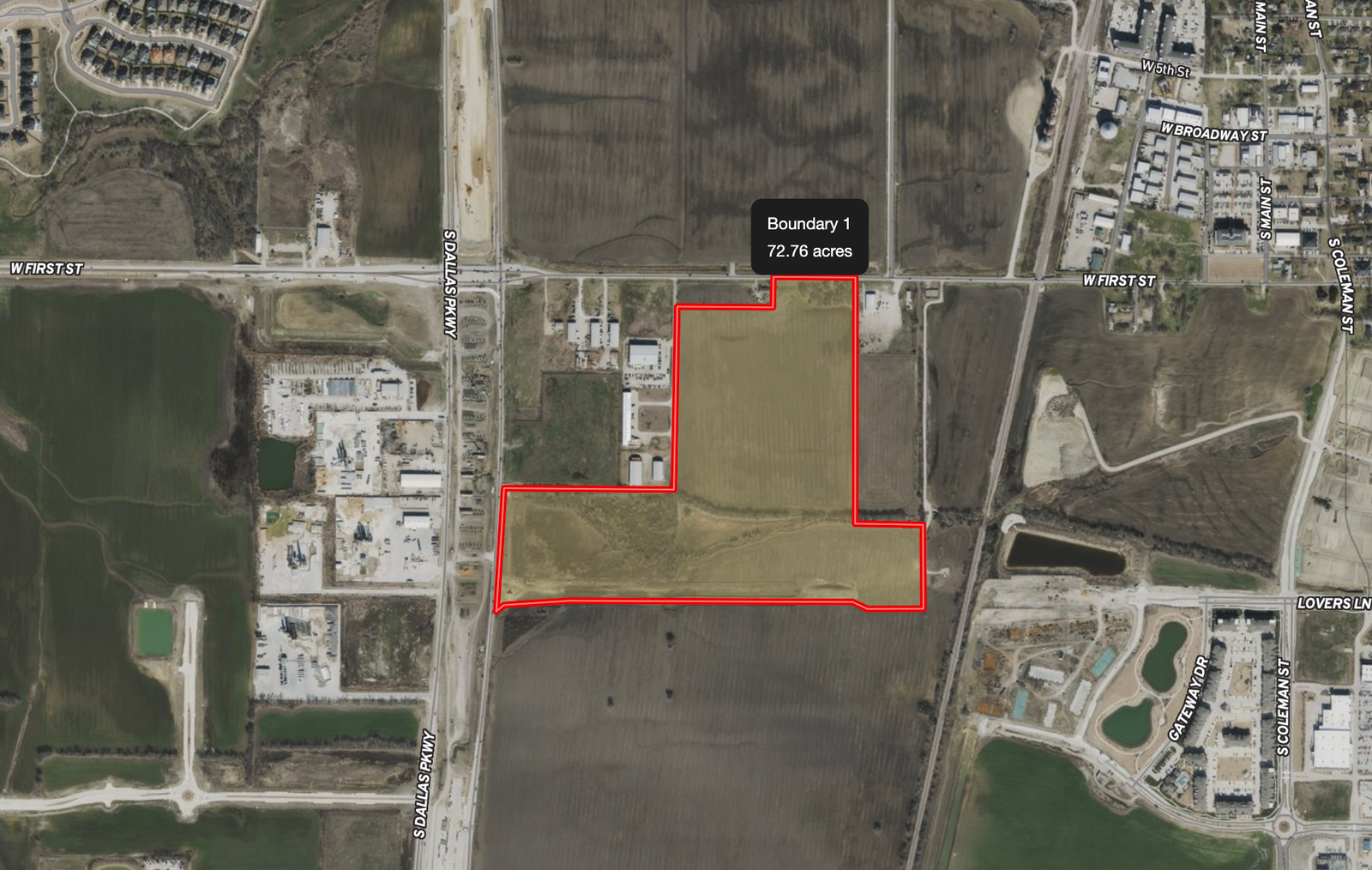
The third Prosper Celina development signal came earlier than the other two. On March 25, Prosper Planning and Zoning approved the preliminary site plan for a 64-acre, 711,000-square-foot office warehouse project from Crow Holdings near Dallas Parkway and First Street. The development includes five buildings. Per Crow’s representative Will Mundinger, the project is modeled on Blue Star Land’s office warehouse development in north Frisco, with roughly 20 percent office build-out and the balance for warehouse and light industrial users.
Mundinger described the buildings as feeling more like value office product than traditional distribution. That distinction matters. Shallow-bay industrial along the Dallas North Tollway corridor serves last-mile logistics, regional service contractors, and small-to-mid users that need warehouse functionality without the deep-bay clear heights of a fulfillment center. It is the industrial product type that follows population, not the kind that creates it.
The site sits in one of Prosper’s seven tollway development subdistricts. Commission Chair Damon Jackson flagged concerns about the building closest to the tollway as a gateway for the town. That tension between industrial demand and visual identity is now a recurring planning conversation along the entire DNT north of Frisco.
Crow Holdings putting 64 acres of shallow-bay product on the tollway sends a clear signal. Institutional capital sees the rooftop math working. The product type follows demonstrated population and consumption, and Crow is underwriting that the demand is durable enough to fill 711,000 square feet.
Why the Three Prosper Celina Development Approvals Read as One Story
Land professionals know the absorption sequence: residential approvals create rooftops, rooftops create commercial demand, commercial absorption creates industrial demand, and industrial absorption thickens the daytime population that pulls in the next round of office and hospitality. That sequence usually plays out over a decade or more in any given submarket.
In the Prosper Celina development corridor, three of those layers got board action within three weeks.
The Celina land swap secures school capacity and a major park amenity, both of which feed residential pricing power for the next wave of MPC build-out. The Coit and University mixed-use adds the commercial density and hospitality keys that demonstrate the corridor has matured beyond pure rooftops. The Crow Holdings warehouse complex puts shallow-bay industrial on the tollway, which is the institutional bet that the residential and commercial layers will hold long enough to fill 711,000 square feet of speculative product.
That convergence is the Prosper Celina development story. The corridor is no longer adding pieces sequentially. It is adding them in parallel.
What Land Investors Should Watch Next
Three monitoring points stand out from this Prosper Celina development convergence.
First, watch how Tellus Group sequences the Teel Parkway and Parvin Road residential entitlement now that the school site is moving. Mosaic’s adjacent build-out timing typically signals the broader Smiley Road absorption pace.
Second, track which hotel flag commits to the Coit and University development as it moves from conceptual to preliminary site plan. The flag tier (full-service luxury, upper upscale, or upper midscale) tells you what corporate underwriters believe about the corridor’s daytime economy two to four years out.
Third, monitor the lease-up velocity on the Crow Holdings buildings once they deliver. Shallow-bay industrial absorption rates north of Frisco have run faster than most underwriting models assumed since 2022. If these buildings lease at the regional pace, expect at least one more institutional industrial entitlement on the DNT corridor within 18 months.
The Prosper Celina development pipeline is now operating as a single market. Read the approvals as a system, not as headlines.
FAQ
Where is the Prosper Celina development corridor located?
The corridor straddles the Collin-Denton county line in north DFW, anchored by US 380 to the south and the Collin County Outer Loop to the north. Prosper sits in both Collin and Denton counties. Celina extends north from Prosper. The two cities share Prosper ISD coverage in significant portions of their footprint, which makes the corridor function as a single submarket for land planning purposes.
Who is Tellus Group?
Tellus Group is the developer behind the Mosaic master-planned community in Celina and is also tied to the Mirabella project in Prosper through a partnership with Highland Homes. The Merritt/Thornton Farm landholding partnership in the Celina land swap is connected to Tellus.
Why does shallow-bay industrial matter for land values?
Shallow-bay industrial typically serves last-mile logistics and regional service tenants. Institutional capital underwrites the product type only after demonstrating that residential and commercial absorption is durable in the surrounding submarket. A 711,000-square-foot speculative project from Crow Holdings is a strong signal that capital views the corridor’s demand as structural, not cyclical.
What is the timeline on the Celina land swap?
Celina Mayor Ryan Tubbs indicated the swap could be finalized within the next several months. Park construction is dependent on future bond funding. The new city parcel carries deed restrictions limiting use to a park and prohibiting development for three years.
How does Prosper Celina development activity affect land pricing in surrounding tracts?
Each of the three approvals tends to lift land values in different ways. The school-and-park trade typically anchors residential pricing within a one-to-two-mile radius. Mixed-use commercial approvals lift retail and pad-site pricing along the corridor. Shallow-bay industrial approvals raise pricing on adjacent industrial-zoned tracts and can pull additional industrial entitlements toward the area. Tracking all three movements in parallel gives a more accurate read on corridor pricing than tracking any one.
References
Primary news coverage of the three approvals
- Community Impact, “Celina eyes 113-acre land trade with Prosper ISD,” April 23, 2026: https://communityimpact.com/dallas-fort-worth/prosper-celina/government/2026/04/23/celina-eyes-113-acre-land-trade-with-prosper-isd/
- Community Impact, “39-acre office, retail and hotel development proposed off US 380,” April 17, 2026: https://communityimpact.com/dallas-fort-worth/prosper-celina/government/2026/04/17/39-acre-office-retail-and-hotel-development-proposed-off-us-380/
- Community Impact, “New 711,000-square-foot office warehouse project proposed near Dallas Parkway in Prosper,” April 14, 2026: https://communityimpact.com/dallas-fort-worth/prosper-celina/government/2026/04/14/new-711000-square-foot-office-warehouse-project-proposed-near-dallas-parkway-in-prosper/
Developer and master-planned community context
- North Texas e-News, “$1.5B Sherley Farms breaks ground in Anna,” March 27, 2026 — Tellus Group portfolio context including Mosaic, Mirabella, and Windsong Ranch: https://www.ntxe-news.com/artman/publish/article_145141.shtml
- CultureMap Dallas, “Serene new $1.5 billion lakeside community coasts into affluent Dallas suburb” — Mosaic master-planned community background and Tellus Group history in north DFW: https://dallas.culturemap.com/news/real-estate/09-16-21-145-billion-master-planned-community-celina-mosaic/
- Mosaic Living (Tellus Group), “Mosaic FAQ” — Acreage, lot count, school zoning, and Dallas North Tollway proximity: https://mosaiclivingtx.com/faq/
- Crow Holdings, “Crow Holdings Industrial — Development Platform” — Industrial development scale and Dallas-area institutional positioning: https://www.crowholdings.com/development/
Corridor and growth framing
- Local Profile, “Why Celina And Prosper Are Among Fastest Growing Wealthy Suburbs In The U.S.” — Population growth metrics for Celina and Prosper, MPC investment scale, and corridor demographic profile: https://www.localprofile.com/real-estate/celina-prosper-fastest-growing-wealthy-suburbs-10202371
- CultureMap Dallas, “Massive new development will add 11,000 homes in well-to-do Dallas suburb” — Centurion American Legacy Hills context and broader Celina MPC pipeline: https://dallas.culturemap.com/news/real-estate/08-04-21-celina-legacy-hills-development-centurion-american-sean-terry/
Municipal primary sources
- Town of Prosper, “Development Services Monthly Report — Development Activity, February 2026” — Active site plan and entitlement records from town planning department: https://www.prospertx.gov/ArchiveCenter/ViewFile/Item/676
- Town of Prosper, “Construction Updates — Coit Road Improvements” — Capital Improvement Program documentation for Coit Road infrastructure expansion that supports the new mixed-use development: https://www.prospertx.gov/341/Construction-Updates