Table of Contents
Call it what it is. The LiteOn McKinney project, a $919 million campus and one of the largest private investments in the city’s history, keeps getting filed under “AI data center.” It isn’t one. FOX ran it as a “massive AI tech investment.” CoStar tagged LiteOn an “AI tech firm.” The label is wrong, and if you price land in Collin County, the error is expensive.
Taiwan’s LiteOn Technology is building an advanced-manufacturing campus, not a server farm. The distinction is not pedantry. A data center and a factory sit on opposite ends of the land, power, water, and jobs spectrum, and confusing them means underwriting the wrong demand.
What LiteOn Is Actually Building
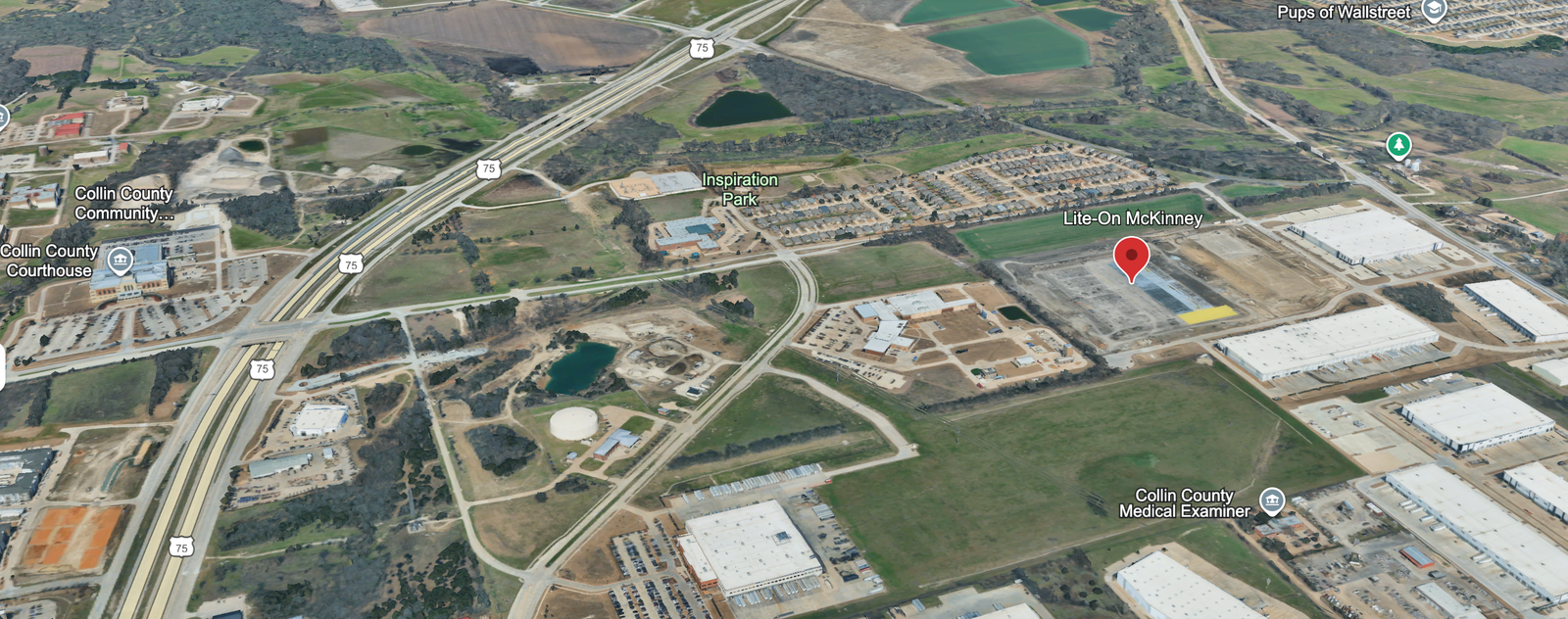
The LiteOn McKinney campus is an advanced-manufacturing and R&D operation that will also serve as the company’s North American headquarters. It will run final assembly, testing, quality verification, and packaging of power management systems, power conversion components, printed circuit assemblies, thermal management materials, and firmware-integrated systems.
Those parts feed AI data centers. The campus is not one.
The commitment is concrete, and much of it predates the announcement:
- $919 million total investment, phased toward a 2027 operational start
- $108.5 million already spent acquiring more than 650,000 square feet of existing industrial space at the Core5 Logistics Center, 300 and 310 Cypress Hill Drive
- 600-plus jobs in engineering, advanced manufacturing, and corporate operations, hired in phases as renovations finish
- End products that supply LiteOn’s clients in the AI infrastructure and energy markets
LiteOn is not a startup chasing a subsidy. Founded in 1975 and headquartered in Taiwan, it runs roughly 77,000 employees worldwide against $5.1 billion in annual revenue, with existing U.S. sites in Plano and Milpitas, California. It weighed competing locations in Washington and Tennessee before choosing McKinney, and workforce demographics drove the pick. The state added a $3.5 million Texas Enterprise Fund grant and a $100,000 Veteran Created Job Bonus.
The confusion has a clean trail. The state’s own phrasing, an “AI power and infrastructure-related solutions manufacturing facility,” got compressed by headline writers into “AI facility,” and from there to “AI data center” in the comment threads.
Why “Factory” Versus “Data Center” Changes the Land Math
For land owners and investors, asset type is not a labeling exercise. It is the demand curve you underwrite.
A hyperscale data center is land-hungry, power- and water-intensive, and light on jobs. It pulls megawatts and substation capacity, strains local water for cooling, and employs dozens once built. The land play around one is about power access, fiber, and pad-ready acreage.
The LiteOn McKinney campus is the inverse. It reuses 650,000 square feet of standing buildings, staffs past 600 people, and draws on manufacturing-grade rather than hyperscale-grade infrastructure. The land play around it is about workforce housing, supplier and logistics space, and industrial inventory near a proven employer.
Same AI tailwind, opposite footprint. Price a nearby parcel off a “data center is coming” assumption and you misjudge everything downstream: the infrastructure draw, the job multiplier, and the type of tenant likely to follow.
One trend the deal confirms is worth tracking on its own. LiteOn bought buildings that were already standing rather than building from dirt. Large manufacturers are increasingly acquiring existing logistics and industrial space to compress timelines, which puts a premium on shovel-ready inventory across the US 75 corridor.
The Demand Ripple: Jobs Pull Rooftops
A manufacturing campus does what a data center cannot. It puts 600-plus paychecks into the local economy and anchors a corporate headquarters. That demand lands on housing, retail, and office space nearby, and along the US 75 corridor it is already taking shape.
Creation Equity’s Long Branch, a $1.3 billion mixed-use development at US 75 and the coming US 380 bypass, is planning roughly 1,600 multifamily units, a 318,600-square-foot office campus, 135,000 square feet of retail, and a 100-room hotel across 155 acres. McKinney has added more than 25,000 residents since 2021. A high-wage employer like LiteOn strengthens the underwriting for exactly that kind of product.
That is the connective tissue land professionals should read. The campus is one node. The rooftops, retail, and office that follow it are the wider opportunity, and they cluster along the same highway spine.
The Quieter Story: A School Board Said No, and It Didn’t Matter
There is a second thread most coverage missed, and it carries its own land signal.
The Texas Comptroller approved the LiteOn McKinney application in early June under the JETI program, the Jobs, Energy, Technology and Innovation Act that replaced the expired Chapter 313 in 2024. JETI grants a 10-year limitation on the school district’s maintenance and operations (M&O) tax value, the largest line in most Texas property tax bills.
Then, on June 29, McKinney ISD trustees unanimously denied it. Unlike the old program, JETI leaves the local school board a real veto even after Comptroller approval. McKinney ISD used it.
The timing explains why. At that same June 29 meeting, trustees adopted a 2026-27 budget carrying a $6 million shortfall, with recapture payments to the state, the “Robin Hood” transfer, climbing more than 6% to nearly $8 million. A JETI limitation would have shrunk the district’s take from its biggest new taxpayer at the exact moment its own math went underwater.
Trustee Kenneth Ussery drew the line: “I do very much want LiteOn to come…but what I do wish is that our economy right now was different for us as a public school district.” Budget pressure, not project opposition.
And LiteOn is building anyway.
Did the Incentive Actually Matter?
Less than the standard playbook assumes. Three facts keep this from becoming an “incentives don’t work” fairy tale. LiteOn had already committed $108.5 million to the site before the vote, so the land decision was locked. JETI only touches the school M&O portion, leaving the city, county, and McKinney Economic Development Corporation contributions plus the state grant intact. And one denial is not a trend.
Strip those caveats down and a signal still stands. A unanimous school-board “no” on the largest piece of a nine-figure abatement did not derail a $919 million campus. For land pros near McKinney National Airport and the US 75 corridor, that reframes the reflex. Abatement risk has long been a standard discount on industrial sites. When a tenant’s logic runs on workforce and infrastructure, the school-district slice becomes a nice-to-have, and sites marked down for “incentive uncertainty” may be underpriced.
What to Watch Next
Three markers will show whether these are one-offs or the start of a pattern:
- Whether other Collin County districts follow McKinney ISD in rejecting JETI limitations as recapture pressure builds
- How quickly LiteOn phases in its 600 jobs, a proxy for whether the regional talent pool holds
- Whether nearby industrial land trades at a premium as the campus ramps toward its 2027 start
The headlines will keep calling it an AI investment, and in a supply-chain sense they are right. But the LiteOn McKinney campus is a factory, not a data center, and it is going up whether or not the school district blesses the tax break. For anyone underwriting land in its orbit, getting both of those facts straight is the difference between pricing the deal and guessing at it.
Tracking industrial land opportunities in the McKinney and US 75 corridor? Request a Collin County Industrial Land Brief to identify sites positioned for advanced-manufacturing demand, with or without a school-district abatement in play.
Reference links: