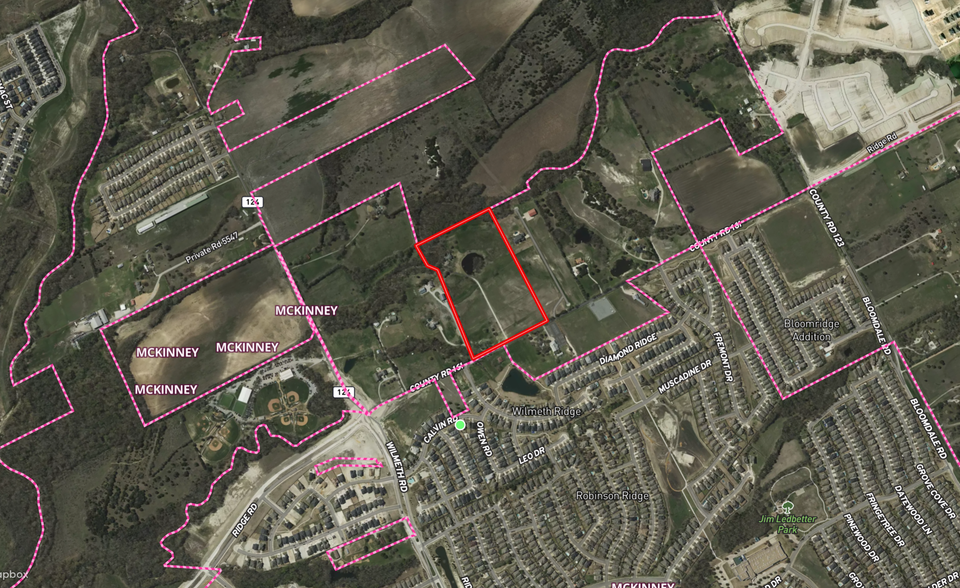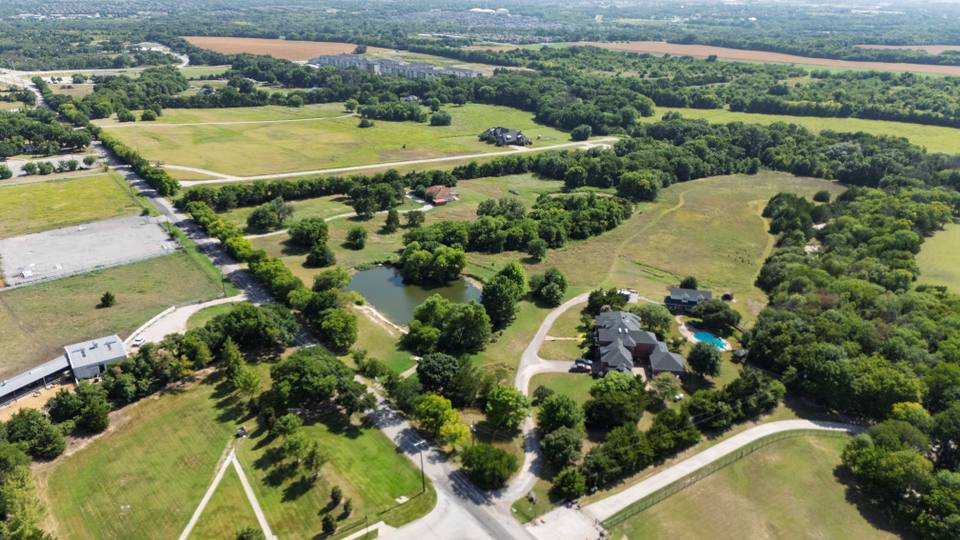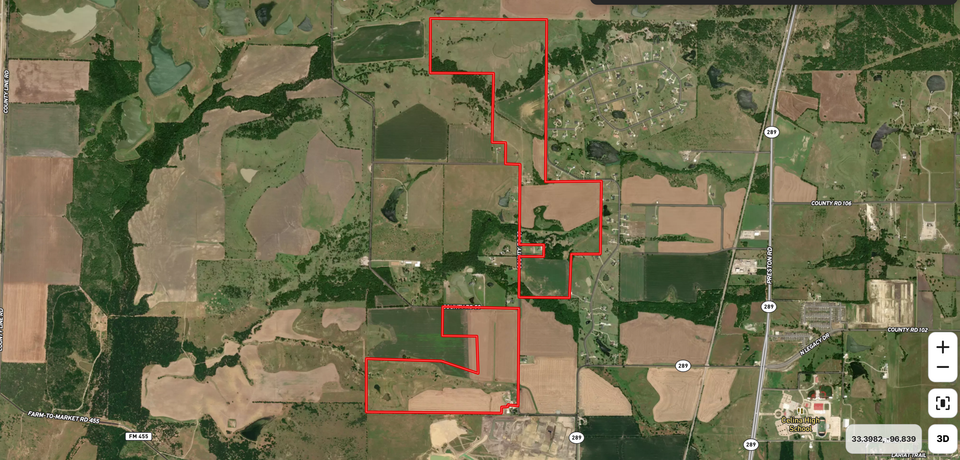
Celina City Council approved voluntary annexations for three tracts totaling 578 acres at its Aug. 11, 2026 meeting. One tract is a 10-acre school site. The other two, totaling 568 acres, are residential and mixed-use ground tied to development agreements signed years ago. Neither owner has a start date. In written responses to questions about this Celina annexation, the city confirmed there is no requirement to develop the property and called that the owner's choice.
That answer is the story. This Celina annexation moved entitled land to the shelf. It did not put lots on the ground.
What the Celina Annexation Covers
The Celina annexation covered three separate tracts approved on the same night. They break down as follows.
TractAcresPlanned useLocationStatusJanet H. Calvert Elementary10Celina ISD Elementary No. 8Southeast of Coit Road and CR 101Road and infrastructure work underway, campus set to open 2027-28Mesa Verde40Detached single-family lots plus 10 acres of open spaceSoutheast of Celina Parkway and CR 59Development agreement approved May 2025, no immediate development plansRobinson528PD No. 166 with Mixed Use, Single-Family Residential Detached and Commercial base zoningEast of Celina Parkway, 3,275 feet north of GA Moore Parkway, Collin CountyAnnexed and zoned Aug. 11, 2026, no immediate development plans
The school site is the only piece of this Celina annexation with a calendar attached. Construction on roads and infrastructure for the Calvert Elementary site is already underway, and the campus is set to open for the 2027-28 school year. Celina ISD funded it through the $2.295 billion bond voters approved in May 2025, which carried Proposition A with roughly 72% support. The line item for Elementary School No. 8 was $73.95 million.
Robinson is the tract worth tracking. A 528-acre planned development with commercial components is a small-city footprint inside a city that is already the fastest-growing in the country.
What the Robinson Zoning Allows After the Celina Annexation
The council zoned the Robinson tract the same night it annexed it. Ordinance No. 2026-073 created Planned Development District No. 166 with three base districts: Mixed Use, Single-Family Residential Detached and Commercial. The property sits in the Gabriel Chenoweth Survey, Abstract No. 140, in Collin County.
Exhibit C splits the land by appraisal district parcel rather than by concept plan. That split is the closest thing to a land plan on record.
ZoningApproximate acresParcelsMixed Use (MU)187Collin CAD 991369, 2652404, 2652403Single-Family Residential Detached (SF-R)340Collin CAD 2663830CommercialUp to 10, by right inside the SF-R tractLocation chosen by the owner at time of development
Two conditions protect the neighbors. No commercial development is permitted within 400 feet of the North Preston Lake subdivision. Any portion of the property adjacent to that subdivision must carry a strip of half-acre home sites zoned SF-R.
What the ordinance does not set is equally important. There is no lot count, no phasing schedule and no minimum density for the single-family portion outside the half-acre buffer strip. Those numbers arrive at preliminary plat, which is also where any assessment district would surface.
What the City Said About Timing, Assessments and Infrastructure
The City of Celina answered six written questions about the Celina annexation and the tracts it covered. The answers were short, and they were consistent on one point: annexation and zoning happened, development did not.
On a construction deadline. There is no requirement to develop the property, the city said. That is the owner's decision. Neither development agreement forces a start date.
On PID or MUD assessments. Unknown, according to the city. The property was annexed and zoned, and nothing beyond that has been determined.
On roads and utilities. Infrastructure is installed at the time of development, in accordance with state law. No improvement schedule exists ahead of a development application.
On neighboring property owners. The Celina annexation itself does not change utility access, road improvements, or the annexation path for adjacent owners outside city limits. Development would change that. No development is planned yet.
For anyone underwriting land near these tracts, that last answer is the one to read twice. Proximity to newly annexed ground creates no entitlement and no utility service by itself. The trigger is a development application, not a council vote.
Why 568 Acres Are Sitting Still
The following is analysis, not city comment.
Celina's housing market softened through 2026. Redfin put the median sale price at $488,734 in June 2026, down 11.4% year over year, with homes averaging 83 days on market. Zillow showed an average home value of $529,873 in May 2026, down 9.9%. The Real Deal, comparing April 2025 to April 2026, found new home sales up 61% while the median closed new-home price fell 22% to $520,000.
Volume is strong and pricing is not. That combination explains the hold, and it frames why this Celina annexation produced no construction schedule.
A developer sitting on an approved agreement has little reason to deliver 500 acres of finished lots into a market absorbing inventory at falling prices. Carrying cost on entitled land is real, but so is the cost of competing with discounted new-home supply. Waiting is a rational underwriting decision, and this Celina annexation puts the owners in position to move when absorption improves without restarting the approval clock.
That is the practical value of the vote. City limits plus a development agreement locks in the utility path, the zoning framework and the city's construction standards. When these owners do pull the trigger, their path from raw ground to recorded lots is shorter than it would be for comparable acreage still sitting in the extraterritorial jurisdiction.
What the Celina Annexation Signals for Nearby Land
Celina's ultimate growth boundary covers nearly 80 square miles, larger than either Frisco or Plano, with a projected build-out population near 378,000. Less than half of that area is inside city limits today. The city reports roughly 600 property owners have signed deferral agreements, and that many owners request annexation specifically to secure zoning protections and future development entitlements.
That is the pattern this vote fits. Owners are buying certainty ahead of demand, and each Celina annexation of this kind converts an ETJ position into a permanent one.
Texas law shapes the mechanism. HB 347, passed in 2019, ended most forced annexation statewide and moved city expansion to a consent-based process. SB 2038, effective Sept. 1, 2023, lets ETJ landowners petition out of a city's extraterritorial jurisdiction entirely. A consent annexation into city limits takes that option off the table permanently, which means owners in these situations are making a one-way decision.
Three things deserve monitoring:
Utility extensions to the school site. Roads and utilities built for Calvert Elementary run toward surrounding acreage. Service capacity near that corner is worth checking before pricing nearby tracts.
The first Robinson plat application. Lot counts, phasing and any PID or MUD filing will surface there, not in the zoning record. The Celina annexation and PD-166 set the envelope, not the yield.
Absorption in the sub-$550,000 band. Celina's reset is the gating factor on all of this supply. When days on market compress, expect activity on both tracts.
What Buyers Should Ask Before Any of This Delivers
The assessment question matters most for future homebuyers, and the Celina annexation record does not answer it. A public improvement district or municipal utility district assessment adds to annual carrying cost, and it rarely appears in builder marketing. The city has not determined whether one is planned for either tract.
Anyone shopping a future phase of Mesa Verde or Robinson should ask for the assessment disclosure in writing before contract, not at closing. The zoning ordinance is silent on the subject, which is normal. Assessment districts ride along with the plat and the financing, not the zoning case.
Two documents will answer most remaining questions about the Celina annexation when they become public: the recorded development agreements for both tracts and the annexation service plans. A Texas Public Information Act request for both is the fastest route.
Celina Annexation FAQ
How many acres did the August 2026 Celina annexation cover?
578 acres across three tracts, approved by City Council on Aug. 11, 2026. Of that total, 568 acres are residential and mixed-use ground. The remaining 10 acres are a school site.
What is the Robinson tract in Celina?
A 528-acre planned development east of Celina Parkway and 3,275 feet north of GA Moore Parkway in Collin County. Ordinance No. 2026-073 zoned it PD No. 166 on Aug. 11, 2026, with roughly 187 acres of Mixed Use, roughly 340 acres of Single-Family Residential Detached and up to 10 acres of commercial by right. No construction timeline exists.
How many homes can be built on the Robinson tract?
The ordinance sets no lot count and no density cap outside a required strip of half-acre home sites next to the North Preston Lake subdivision. Lot counts are determined at platting.
Where is Mesa Verde in Celina?
A 40-acre tract southeast of Celina Parkway and CR 59, planned for detached single-family lots with 10 acres of open space. The development agreement dates to May 2025.
When will Mesa Verde and Robinson be built?
No date has been set. The city confirmed that no requirement to develop exists and that timing is the property owner's choice.
Can Texas cities still force annexation?
Largely no. HB 347 moved the state to a consent-based process in 2019, which is why the Celina annexation of these tracts required owner petitions.
Where is Celina ISD's eighth elementary school?
Janet H. Calvert Elementary sits on a 10-acre site southeast of Coit Road and CR 101, with an opening set for the 2027-28 school year.
The Bottom Line
The Celina annexation of 578 acres expands the city's inventory of shovel-ready ground without adding a single home to the pipeline this year. The school opens in 2027-28. Everything else waits on the market.
For land owners and investors in Collin and Denton counties, this is a supply signal with a delay built in. Track it now. The entitlement work is done, and the trigger is absorption, not approval.
Request a North Texas Entitlement Watch brief to see which Celina and Prosper corridor tracts carry active development agreements, and where utility extensions are moving next.
References
Community Impact, "Celina adds 578 acres to city limits for new developments, planned elementary school," Sept. 4, 2026. Cited for: the Aug. 11 annexation of three tracts totaling 578 acres and the Calvert Elementary site location.
City of Celina, Ordinance No. 2026-073, adopted Aug. 11, 2026 (provided by the city). Cited for: PD No. 166 zoning, survey and county, the parcel-by-parcel use split, and the North Preston Lake buffer standards.
City of Celina, written responses to questions submitted by The Texas Land Agent, September 2026. Cited for: no development requirement, unknown assessment status, infrastructure timing, and effect on adjacent owners.
City of Celina, Annexations. Cited for: the 80-square-mile growth boundary, the 378,000 build-out projection, and deferral agreement counts.
Celina ISD, Bond 2025. Cited for: the $2.295 billion bond and the Elementary School No. 8 line item.
Redfin, Celina housing market. Cited for: June 2026 median sale price and days on market.
Zillow, Celina home values. Cited for: May 2026 average home value.
The Real Deal, "New home sales explode in Celina, Texas," 2026. Cited for: the April 2025 to April 2026 new-home sales and price change.
Texas HB 347 (2019), enrolled text. Cited for: the end of most forced annexation.
Texas SB 2038 (2023), Senate Research Center analysis. Cited for: ETJ release petitions.
Related: Celina Water Supply: What It Means for Land in the Corridor