Table of Contents
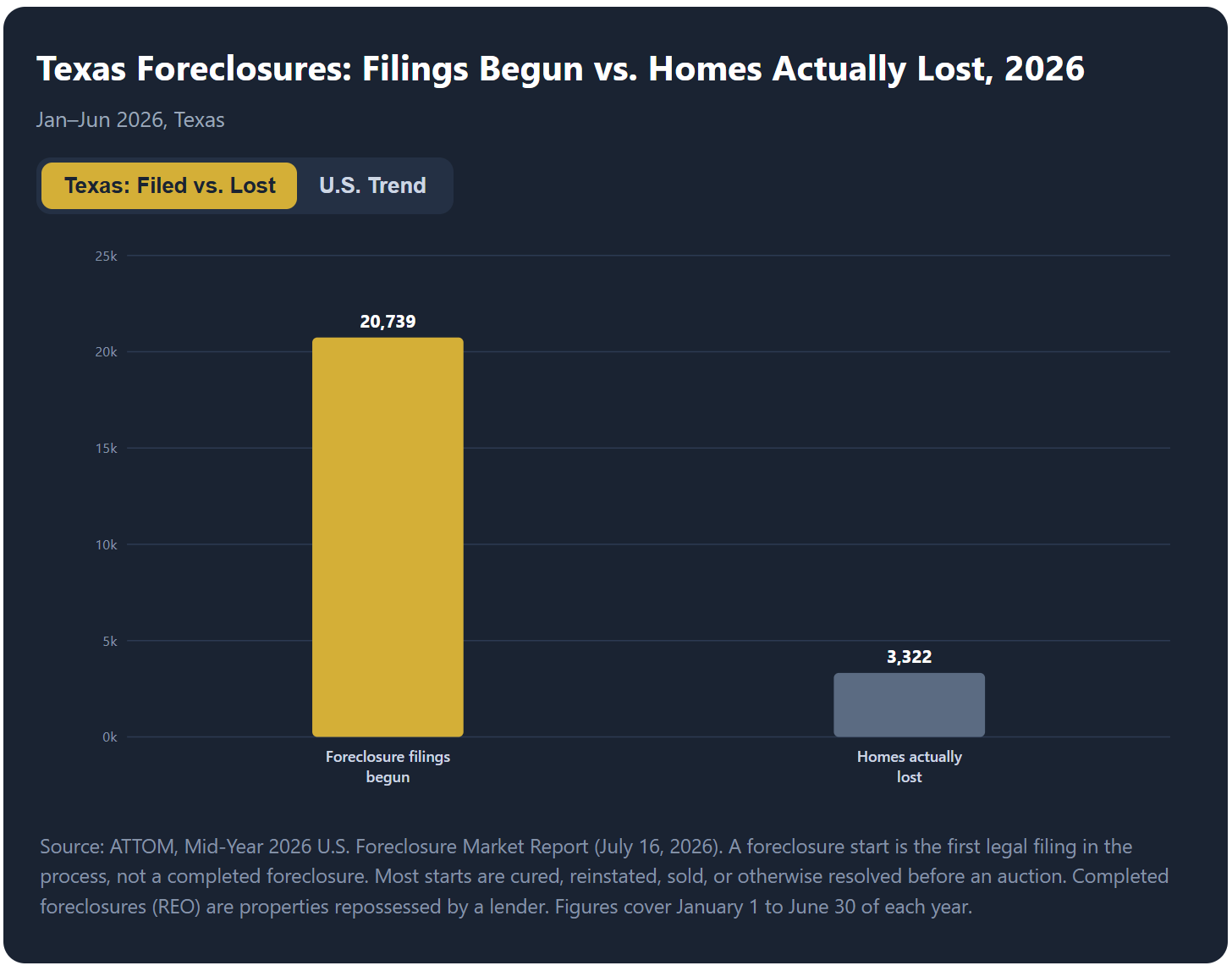
More than 2,700 properties across Collin, Dallas, Denton, and Tarrant counties entered foreclosure in the first four months of 2026, roughly a third more than the same stretch last year, according to a regional brokerage analysis of ATTOM data. The increase is not isolated to North Texas. ATTOM’s own Mid-Year 2026 U.S. Foreclosure Market Report confirms Texas led the nation in foreclosure starts, posting 20,739 in the first six months of the year alone. For investors and buyers who have been priced out of a tight resale market, North Texas foreclosures are starting to look like a real entry point rather than a rumor.
This is not 2008. Today’s defaults are sitting on real equity, not underwater paper. But the volume shift is large enough that anyone watching the Metroplex land and housing market needs to understand what is driving it, where it is concentrated, and what it actually means for acquisition strategy.
What’s Driving the Increase in North Texas Foreclosures
The mechanics behind this cycle differ sharply from the last one. Rising property taxes and insurance premiums, not bad underwriting, are pushing homeowners past their monthly limits. A homeowner near McKinney who never missed a payment can still end up in foreclosure once an escrow account jumps $400 a month from tax and insurance increases alone, with the loan balance untouched.
Nationally, ATTOM counted 227,548 properties with foreclosure filings in the first half of 2026, up 21% year over year and up 28% from the same period two years earlier. Texas carried a disproportionate share of that growth: the state posted 22,000 total foreclosure filings in the first half of the year, a 19.71% annual increase, and led the country with 3,322 completed bank repossessions. North Texas foreclosures make up a meaningful piece of that statewide total given the region’s population and construction volume over the past decade. Anyone tracking North Texas foreclosures closely will notice the numbers concentrate in the counties that saw the heaviest homebuilding activity between 2019 and 2023.
Slower resale activity compounds the pressure. Listing inventory across the major Texas metros is running about 53% above normal levels, according to regional brokerage data. That means a homeowner who needs to sell before an auction date has fewer buyers competing for the property and less leverage to negotiate a fast close.
The State Picture Behind North Texas Foreclosures
Zoom out and North Texas foreclosures fit inside a broader Texas foreclosure story. Realtor.com’s July 2026 report on the national foreclosure market found that foreclosure listings climbed to their highest share of active inventory in six years, reaching 1.3% in April 2026. That is up from a recent low and closing in on the 1.7% share recorded in April 2020.
The same report found that foreclosed homes sold at a median discount of 27.2% below estimated market value. Realtor.com’s senior economist Joel Berner framed the increase as a return to pre-pandemic norms rather than the start of a crisis, noting that forbearance and moratorium programs from the pandemic era fully wound down in 2024 and that the homeowners feeling the most pressure are the ones who bought at peak prices and are now squeezed by rising insurance, taxes, and adjustable-rate payments.
Bank-owned, or REO, listings drew 26.5% more online views than typical listings in the first half of 2026, even though they sat on the market 11 days longer on average. Part of that gap comes down to marketing: REO listings carry 30.4% fewer photos and property descriptions that run about a third shorter than standard listings. Most sell as-is, so buyers absorb whatever repairs are waiting on the other side of closing.
Austin offers a useful comparison point outside the core North Texas footprint. ATTOM data cited by The Real Deal showed Austin’s foreclosure rate grew nearly 199% year over year in April 2026, the largest increase among major U.S. metros. Austin home prices have fallen roughly 8% since their 2022 peak, and buyers who put down the minimum on FHA loans during that run-up are now among the most exposed. The pattern reinforces the same underlying story playing out in North Texas: pandemic-era buyers with thin equity cushions are the ones showing up in foreclosure data first.
Texas Foreclosures: Filings Begun vs. Homes Actually Lost, 2026
Jan–Jun 2026, TexasSource: ATTOM, Mid-Year 2026 U.S. Foreclosure Market Report (July 16, 2026). A foreclosure start is the first legal filing in the process, not a completed foreclosure. Most starts are cured, reinstated, sold, or otherwise resolved before an auction. Completed foreclosures (REO) are properties repossessed by a lender. Figures cover January 1 to June 30 of each year.
What This Means for North Texas Land and Property Investors
Texas foreclosures still move faster than in any other state. Nonjudicial foreclosure under a deed-of-trust power-of-sale clause means no courtroom is required, and ATTOM’s Mid-Year 2026 report puts the average Texas foreclosure timeline at 155 days, the shortest of any state in the country, though contested files run longer. For an investor doing diligence on North Texas foreclosures, that speed cuts both ways. It shortens the window to negotiate directly with a homeowner before a trustee sale, and it means auction calendars fill and clear quickly across Collin, Denton, Dallas, and Tarrant counties.
Equity remains the deciding factor in how much room a seller has to maneuver. National Association of Realtors data points to average owner equity growth near 50% over the past five years, which means most sellers behind North Texas foreclosures still have options: a straight sale, a short sale, a loan modification, forbearance, or a deed in lieu of foreclosure. Buyers approaching these owners should expect negotiations grounded in real value, not desperation pricing.
For land and acreage buyers specifically, rising foreclosure volume in the surrounding residential market is often a leading indicator of softer land pricing at the fringe of fast-growing counties. That softening is already visible in the data: North Texas land prices fell 7.5% across the eight-county footprint in the first half of 2026, with Denton and Collin counties repricing hardest. When resale inventory backs up and foreclosure filings climb, sellers of adjacent raw and transitional land tend to become more flexible on price and terms…
What to Watch Next
Monthly ATTOM foreclosure data and county trustee-sale postings remain the most reliable early signals for tracking North Texas foreclosures going forward. Watch for continued growth in Collin and Denton county filings specifically, since both sit inside the fastest-growing corridors of the eight-county North Texas footprint and typically show foreclosure activity before it registers in statewide averages. Also track listing inventory levels; the current 53% above-normal reading in major Texas metros needs to come down meaningfully before foreclosure-driven price softening reverses.
None of this points toward a 2008-style collapse. It points toward a market correcting off pandemic-era peaks, with foreclosure activity as one of several signals confirming the adjustment. For buyers and investors positioned to move quickly and do proper title and equity diligence, North Texas foreclosures represent a genuine, if narrow, opportunity window rather than a red flag.
FAQ: North Texas Foreclosures
How many properties entered foreclosure in North Texas in 2026?
More than 2,700 properties across Collin, Dallas, Denton, and Tarrant counties entered foreclosure in the first four months of 2026, about a third more than the same period in 2025, according to a regional brokerage analysis of ATTOM data.
Is this a repeat of the 2008 housing crash?
No. Homeowners entering foreclosure today generally carry real equity built up over the past five years, unlike the underwater loans that drove the 2008 crisis. National Association of Realtors data shows average owner equity growth near 50% over that period.
What discount do foreclosed homes typically sell for?
Realtor.com’s July 2026 report found a median discount of 27.2% below estimated market value for foreclosed homes nationally, within the 20% to 35% range the metric has held since 2018.
How fast does foreclosure move in Texas?
Texas uses nonjudicial foreclosure through a deed-of-trust power-of-sale process, avoiding the courtroom entirely. ATTOM’s Mid-Year 2026 report puts the average Texas foreclosure timeline at 155 days, the shortest of any state, though contested cases take longer.
References
- ATTOM — “Foreclosure Activity Posts Annual Increase in First Half of 2026” (July 16, 2026)
https://www.prnewswire.com/news-releases/foreclosure-activity-posts-annual-increase-in-first-half-of-2026-302827085.html - ATTOM — “Foreclosure Activity Rises in Q1 2026 as Market Continues to Normalize” (April 16, 2026)
https://www.prnewswire.com/news-releases/foreclosure-activity-rises-in-q1-2026-as-market-continues-to-normalize-302743932.html - DaltxRealEstate — “North Texas Foreclosures Jump, But Equity Still Buys Time”
https://daltxrealestate.com/north-texas-foreclosure-alternatives/ - Realtor.com / PRNewswire — “Want a Discount on Your Next Home? Realtor.com’s New Report Says Look at Foreclosures” (July 7, 2026)
https://www.prnewswire.com/news-releases/want-a-discount-on-your-next-home-realtorcoms-new-report-says-look-at-foreclosures-302818607.html - The Real Deal — “Austin Leads Nation in Home Foreclosure Growth as Stubbornly High Pricing Proves Sticky” (May 20–21, 2026)
https://therealdeal.com/texas/2026/05/20/residential-foreclosures-tick-up-in-austin/