Table of Contents
Dallas North Tollway corridor development is no longer a single-project story. It is a 14-mile stretch of pavement pushing north from US 380 toward the Grayson County line, rewriting land values, development economics, and population projections across Collin and Denton counties for the next 30 years.
This is what a generational land use shift looks like when you catch it mid-build.
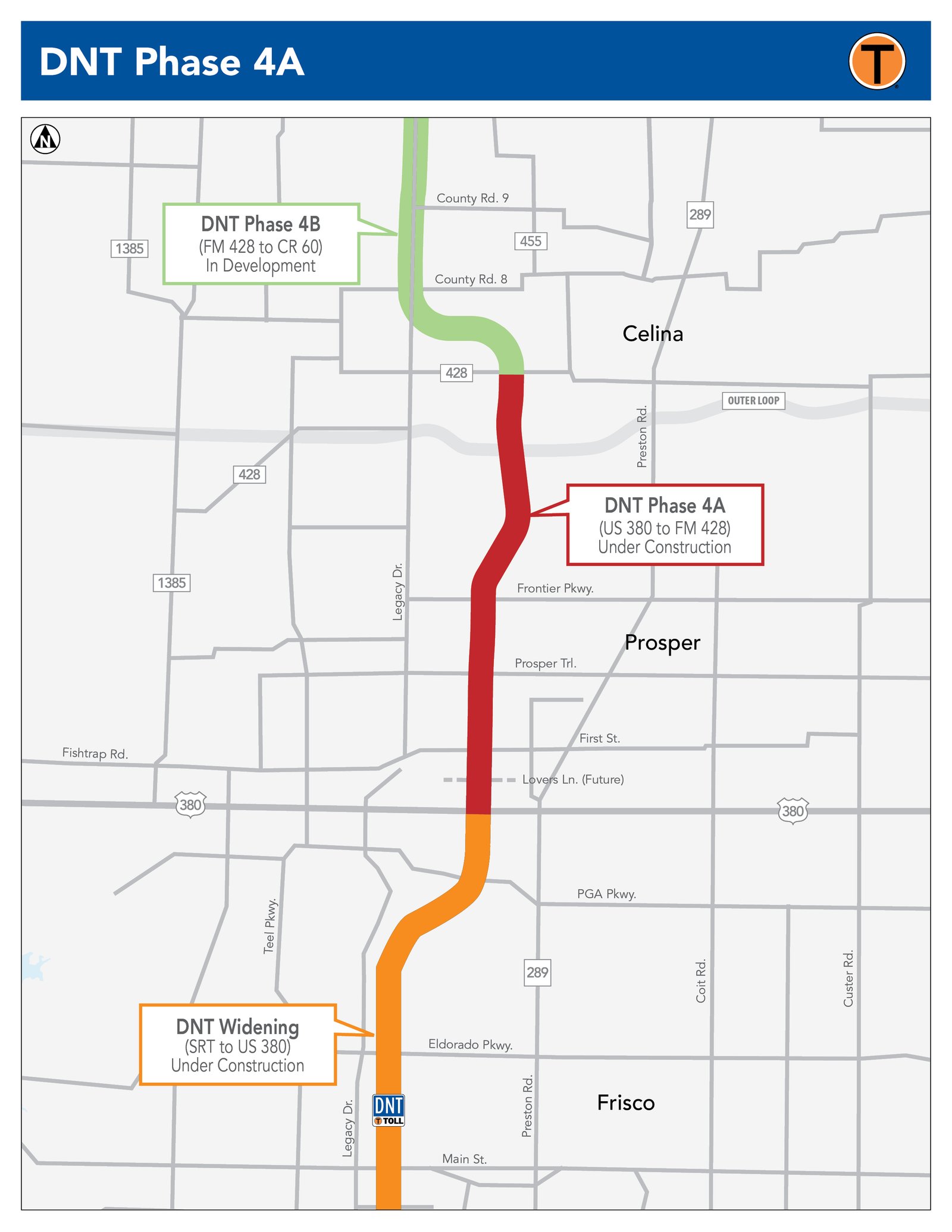
The North Texas Tollway Authority is roughly 18 months from completing Phase 4A, the $460 million, six-mile extension from US 380 to FM 428 in Celina, slated to open in fall 2027. Phase 4B, extending the tollway from FM 428 to the Grayson County line, is queued behind it. By the time both phases finish, the DNT will connect downtown Dallas directly to communities that did not exist as meaningful population centers a decade ago.
Developers are not waiting. They are moving now.
What Makes Dallas North Tollway Corridor Development Different
Most highway expansions chase demand. The DNT extension is doing both. It is chasing existing demand and creating the conditions for the next wave. Celina Mayor Ryan Tubbs has described the relationship as mutually beneficial, with NTTA’s $400 million investment landing on top of future investment to come.
The numbers behind that statement are worth parsing.
Celina’s population has grown from roughly 1,700 in 2000 to over 60,000 in 2025. Census projections show the city could reach 378,000 residents over the next two decades. Prosper is projected to peak at 72,000. Collin County as a whole has added more than 200,000 residents since the 2020 census, with the northern edge and the land just across the line into Grayson County drawing the bulk of new developer attention.
This is not suburban infill. This is the construction of an entirely new band of metropolitan Dallas, and Dallas North Tollway corridor development is the spine running through the middle of it.
The Developers Already Locked In
Three categories of Dallas North Tollway corridor development are moving simultaneously: large-format master-planned residential, anchor commercial and retail, and shallow-bay industrial and mixed-use. Each tells you something different about how capital is reading the corridor.
Master-planned residential. Huffines Communities broke ground on Serenade Texas in March. It is a 468-acre, $100 million project near Preston Road and Marilee that will deliver roughly 1,000 home sites at buildout. Hillwood’s Ramble is a 1,380-acre development targeting 4,000 homes with a mid-2026 opening. Centurion American is building Legacy Hills, a multi-thousand-home community on the western side of Celina. Huffines founder Don Huffines has publicly framed Celina as a market that has not fully priced in what is coming, citing the Sherman-area semiconductor buildout by Texas Instruments and GlobiTech as a demand driver that has not shown up in land values yet.
Anchor commercial. Shawnee Trail, the 150-acre Walmart-anchored mixed-use project, broke ground in late April. That signals grocery and big-box retail are now willing to underwrite Celina as a primary trade area rather than an emerging one. That is a meaningful threshold for a corridor that, five years ago, was still being modeled as exurban overflow.
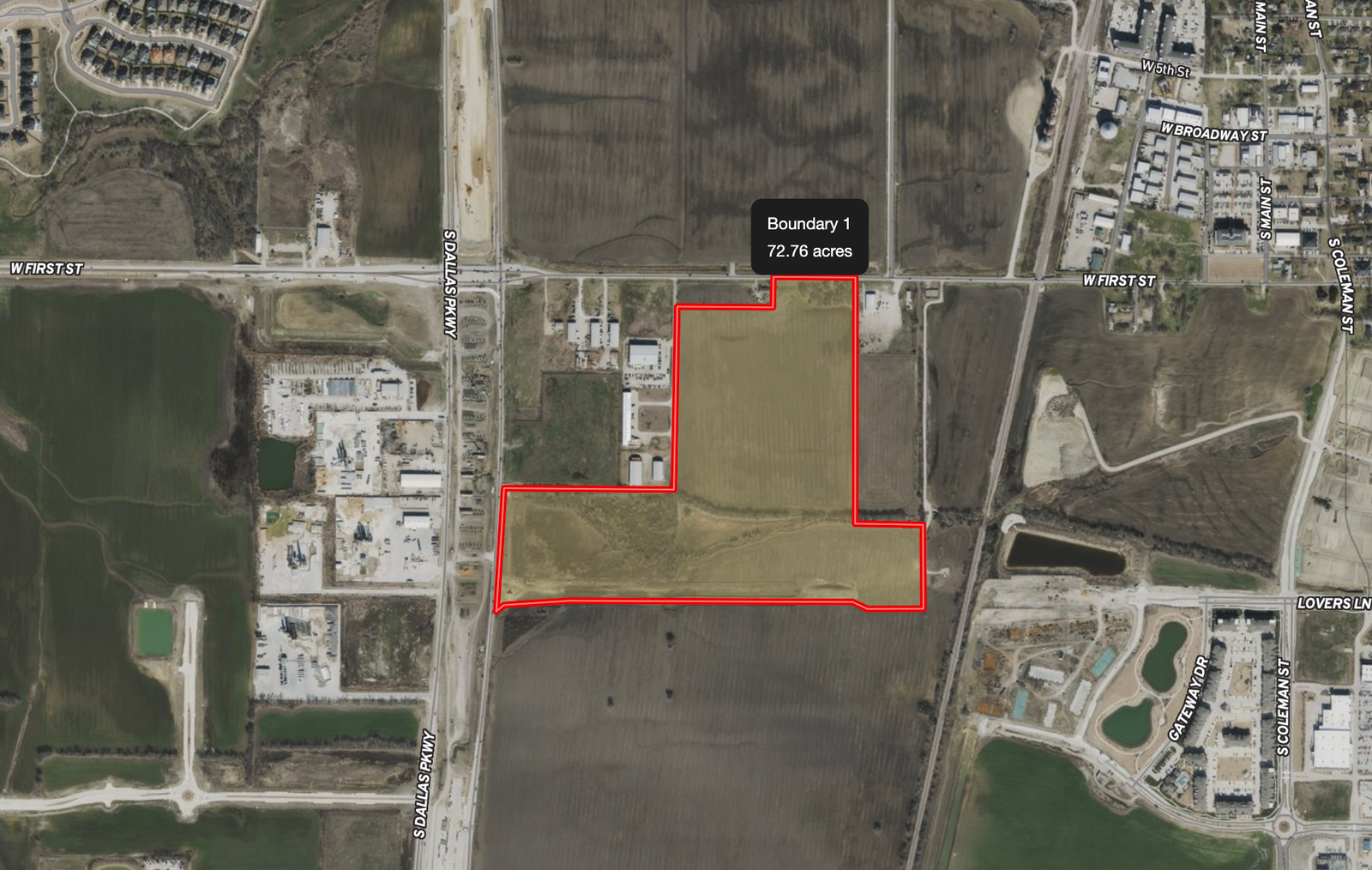
Shallow-bay industrial and mixed-use. Crow Holdings is advancing a 711,000-square-foot office warehouse project on 64 acres at Dallas Parkway and First Street in Prosper, modeled on Blue Star Land’s similar project in north Frisco. A separate 39-acre mixed-use development at Coit Road and University Drive in Prosper was approved in April, featuring a hotel, office, and retail buildings totaling 287,850 square feet. Both projects sit directly within the future Dallas North Tollway corridor development zone.
The pattern across all three categories is consistent. Developers are entering at price points that still pencil, locking in positions before infrastructure delivery compresses entry costs.
The Generational Framing
This is where Dallas North Tollway corridor development stops being a news cycle and becomes a structural story.
Highway corridors do not transform regions evenly or temporarily. They reshape them in 30-year cycles tied to absorption, school district capacity, and the slow accumulation of corporate site selection decisions. The Tollway already did this once, to Plano in the 1990s and Frisco in the 2000s. Legacy West and The Star did not exist before the DNT pushed past LBJ Freeway and then past 121. They became possible only after the infrastructure was committed.
Celina’s economic development director Anthony Satarino has been explicit about the model the city is targeting. Projects similar to Frisco’s The Star or Plano’s Legacy West are exactly what city leadership wants sprouting along the new tollway segments. Whether those exact projects materialize is less important than the underlying logic. Once a tollway corridor commits to a city, the playbook for what gets built there narrows considerably.
That playbook is now active in Prosper and Celina. It will be active in northern Celina and southern Grayson County within five years, and Dallas North Tollway corridor development will be the central organizing variable.
What’s Driving the Capital Flow
Four forces are stacking simultaneously. They are the reason Dallas North Tollway corridor development is attracting serious institutional money rather than just speculative land flips.
- Infrastructure certainty. Phase 4A is funded, under construction, and on schedule. Phase 4B is in design. The Collin County Outer Loop’s Segment 3C opened in November 2025, connecting Celina to McKinney via a new east-west spine. That is the kind of layered infrastructure commitment that institutional capital underwrites against.
- Semiconductor demand at the northern terminus. Texas Instruments and GlobiTech are constructing multi-billion-dollar fabs in Sherman expected to generate roughly 3,000 high-tech jobs in Grayson County. Workers will need housing within a reasonable commute. The DNT extension makes that commute viable from Celina northward.
- School district capacity. Celina ISD, Prosper ISD, and the surrounding districts are still in active expansion mode, with bond capacity to build schools ahead of rooftops. That is a major variable for master-planned community developers, who need school commitments locked in before they can market homesites.
- Land prices that still work. Tracts along Preston Road between FM 455 and the Grayson County line still trade at price points where 400-acre, 1,000-home master-planned communities can be financed. That window is closing. Once Phase 4A opens in 2027, the math shifts.
What to Watch in the Next 24 Months
Three signals will tell you whether the Dallas North Tollway corridor development thesis is playing out faster or slower than the current consensus expects.
Land assemblage activity north of Celina city limits. Tracts in the Celina ETJ and across the line into Grayson County are the next layer. Watch for institutional buyers, including REITs, public homebuilders, and infrastructure-focused private equity, taking large positions in 2026 and early 2027.
Phase 4B construction commitments. NTTA has not published a firm construction start date for Phase 4B. The contract award, design milestones, or funding announcements will signal how aggressively Dallas North Tollway corridor development extends toward the Grayson County line.
Corporate site selection announcements. Frisco’s transformation did not start with residential. It started with corporate relocations to Legacy West and The Star. The first major corporate Class A office or headquarters announcement along the Phase 4A segment will mark the moment the corridor moves from residential boomtown to integrated employment center.
My thoughts
Dallas North Tollway corridor development happening right now is the front half of a 30-year build-out. The communities planning around it, including Prosper and Celina coordinating mixed-use along the new corridor, Celina council members rejecting downtown design code modifications to preserve character, and Collin County funding Outer Loop segments, are doing the work that determines whether this corridor matures into the next Legacy West or sprawls into the next cautionary tale.
The land story has already been written for the first six miles. The next eight are still in play.
For investors, developers, and land owners along the Preston Road and Dallas Parkway corridor, the window between now and Phase 4A’s fall 2027 completion is the part of the cycle worth watching closely. Dallas North Tollway corridor development is the variable that defines everything else.s
When will the Dallas North Tollway extension reach Celina?
Phase 4A of the Dallas North Tollway extension, which runs six miles from US 380 to FM 428 in Celina, is scheduled to open in fall 2027. The North Texas Tollway Authority approved a $460 million construction contract with Sinacola in December 2023, and construction is currently active along the corridor. Phase 4B, which will extend the tollway from FM 428 to the Grayson County line, is in the design phase with no firm construction start date yet announced.
What developments are being built along the Dallas North Tollway corridor?
Major Dallas North Tollway corridor development projects currently underway or recently announced include Serenade Texas (468 acres, Huffines Communities), Ramble (1,380 acres, Hillwood), Legacy Hills (Centurion American), Shawnee Trail (150-acre Walmart-anchored mixed-use), Crow Holdings’ 711,000-square-foot office warehouse on 64 acres in Prosper, and a 39-acre mixed-use development at Coit Road and University Drive in Prosper. Combined, these projects represent thousands of acres and over 10,000 planned residential units along the future corridor.
How far north will the Dallas North Tollway eventually extend?
NTTA’s planned Phase 4 extension will run approximately 14 miles north of US 380, completing at the Collin and Grayson county line. A proposed Grayson County Regional Mobility Authority project could extend the tollway further into Grayson County beyond that point, though that segment remains in planning.
Why are developers buying land in Celina and northern Collin County now?
Four factors are driving institutional capital into the corridor before the tollway opens: confirmed infrastructure delivery on Phase 4A, semiconductor manufacturing demand at the northern end from Texas Instruments and GlobiTech in Sherman, school district bond capacity in Celina ISD and Prosper ISD, and land prices that still allow large master-planned communities to be financed. The expectation is that once Phase 4A opens in 2027, entry pricing along the corridor will compress significantly.
How does the Collin County Outer Loop affect the Dallas North Tollway corridor?
Segment 3C of the Collin County Outer Loop opened in November 2025, connecting Celina to McKinney via an 8.9-mile east-west route that links the Dallas North Tollway to US 75. Additional Outer Loop segments connecting Choat Parkway in Celina to the Denton County line are in design, with construction expected to begin in 2026. The combined effect is a layered grid of north-south and east-west infrastructure that supports broader Dallas North Tollway corridor development across multiple counties.
References
- WFAA — “Dallas North Tollway drives growth in North Texas cities like Frisco and Prosper” — August 26, 2025 https://www.wfaa.com/article/news/special-reports/boomtown-dfw/dallas-texas-growth-north-tollway-development-prosper-celina-frisco/287-961989d8-99b0-43a4-8c0b-2d38b17baecb
- WFAA — “Dallas North Tollway expansion could transform Celina into North Texas’ next boomtown” — August 21, 2025 https://www.wfaa.com/article/news/local/dallas-north-tollway-expansion-could-transform-celina-north-texas-next-boomtown/287-47015cb9-e56d-4ab0-8f46-b860d87be1f3
- Community Impact — “Paving new ground: Area growth drives need for $460M Dallas North Tollway extension through Prosper, Celina” — March 26, 2024 https://communityimpact.com/dallas-fort-worth/prosper-celina/transportation/2024/03/26/paving-new-ground-area-growth-drives-need-for-460m-dallas-north-tollway-extension-through-prosper-celina/
- Community Impact — “Development plans underway for future tollway corridor in Prosper, Celina” — May 21, 2026 https://communityimpact.com/dallas-fort-worth/prosper-celina/development/2026/05/21/development-plans-underway-for-future-tollway-corridor-in-prosper-celina/
- Community Impact — “See 5 housing developments making headway in Prosper, Celina” — May 22, 2026 https://communityimpact.com/dallas-fort-worth/prosper-celina/development/2026/05/22/see-5-housing-developments-making-headway-in-prosper-celina/
- Local Profile — “Collin County Opens $62.7 Million Outer Loop Linking Celina And McKinney” — November 10, 2025 https://www.localprofile.com/news/collin-county-outer-loop-celina-mckinney-11468827
- Community Impact — “Collin County completes, opens Outer Loop connection from Celina to McKinney” — November 8, 2025 https://communityimpact.com/dallas-fort-worth/mckinney/transportation/2025/11/07/collin-county-completes-opens-outer-loop-connection-from-celina-to-mckinney/
- North Texas Tollway Authority — Dallas North Tollway project page and Phase 4 progress reporting https://www.ntta.org/dallas-north-tollway-dnt
- City of Celina — Dallas North Tollway Phase 4 Progress Report https://www.celina-tx.gov/DocumentCenter/View/3563/DNT-Phase-4-Progress-Report