Texas held its title as the #1 state for new residents in 2025, but the numbers tell a more complicated story. According to the U.S. Census Bureau, the state added 391,243 residents in the 12 months ending July 2025, bringing total population to 31.7 million. That growth rate of 1.2% is the slowest since 2021. The Texas population growth slowdown is confirmed, and land professionals need to understand what’s driving it and what it signals for demand.
The Numbers Behind the Texas Population Growth Slowdown
The Census Bureau measures population change through three channels: natural increase (births minus deaths), net domestic migration from other states, and net international migration from abroad.
Texas has been growing from all three. But the composition shifted sharply in 2025.
Natural increase contributed 157,111 residents, with 390,203 births against 232,492 deaths. That figure held relatively steady compared to prior years. The disruption came from migration.
Net domestic migration fell to 67,299, down dramatically from 222,154 in 2022. International migration dropped even harder: 167,475 new residents arrived from abroad in 2025, a 48% decline from 319,569 the prior year. Both figures mark multi-year lows.
Total growth is still positive. But the engines driving that growth have downshifted significantly.
Two Forces Driving the Slowdown
Domestic migration is cooling. Texas built its relocation advantage on affordability, low taxes, and business climate. That advantage has narrowed. Rising home prices across major metros closed the cost gap between Texas and competing states in the South and Midwest. States like South Carolina, North Carolina, and Idaho have also become more competitive destinations, with South Carolina ranking as the fastest-growing state by percentage in 2025.
Texas still attracts more total movers than any other state. But the gap has closed enough that domestic migration is now near a decade low.
International migration declined faster. The Trump administration’s stricter immigration enforcement drove a 48% drop in international arrivals to Texas in 2025. Nationally, net international migration fell 55% to 1.3 million, described by Census Bureau officials as a “historic decline.” Projections show it could fall further to approximately 321,000 nationally in the coming year. Since Texas has been one of the top destinations for international arrivals, the downstream effect on the state’s growth trajectory will be significant.
The TRERC analyst notes the 2025 data captures only the early months of current immigration policy. Future estimates will reflect the full impact.
What the Texas Population Growth Slowdown Means for Land Markets
The instinct is to read this as bearish. Fewer new residents means reduced housing demand, slower commercial absorption, and less upward pressure on land prices. That is partially true. But for land professionals the picture is more nuanced.
Residential land acquisition pressure eases. High-growth corridors around DFW, Austin, San Antonio, and Houston have been absorbing land at a pace that stretched infrastructure and inflated acquisition premiums. A moderation in population inflow reduces that urgency. For buyers who were priced out of active submarkets during peak growth years, this Texas population growth slowdown creates a re-entry window at more defensible basis levels.
Infrastructure investment catches up. Rapid growth outpaced municipal capacity across North Texas communities. Roads, utilities, school systems, and water infrastructure have been under strain. Lloyd Potter, the Texas state demographer, noted there is now potential breathing room for local governments to catch up on infrastructure needs. For land investors with a longer time horizon, that catch-up increases the development viability of parcels that were previously difficult to permit.
Rural land demand stabilizes rather than collapses. The Texas population growth slowdown does not eliminate rural land demand. Natural increase continues. Net migration remains positive. The underlying drivers of rural land, including agricultural productivity, recreational value, and conservation use, are largely independent of short-term migration flows. Per TRERC’s analysis, Texas growth is normalizing toward what most states would consider strong performance. It is recalibration, not retreat.
The North Texas Angle
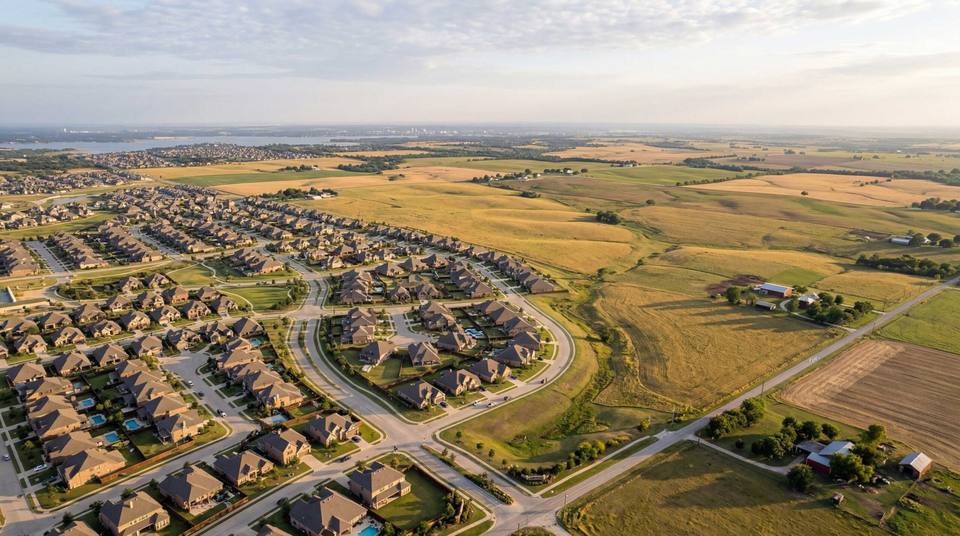
North Texas absorbed a disproportionate share of domestic migration over the past decade. Collin County added nearly 43,000 new residents in 2025 alone, with 83% of that growth driven by migration. The DFW corridor drew heavily from California, Illinois, and New York throughout the post-2020 boom.
As domestic migration moderates nationally, that inbound flow to Collin, Denton, Wise, and surrounding counties will soften. That said, the region’s economic base has diversified well beyond relocation-driven demand. Corporate relocations, data center investment, and manufacturing expansion continue to generate employment growth and housing demand independent of individual migration patterns.
The Texas population growth slowdown is a headwind in North Texas, not a reversal. Developers and land sellers in the outer suburban ring should adjust absorption timeline assumptions accordingly.
How to Position in a Slower-Growth Market
For land professionals, the useful framing is this: the Texas population growth slowdown changes the pace of demand, not the direction. Texas still leads the nation in total new residents. Job growth continues. The state has added 2.6 million residents since 2020, more than any other state in the country.
What changes is the margin for error on land deals. Projects underwritten on 2022-era absorption velocity need a second look. Patience becomes more valuable. Submarkets with strong employment anchors, not just migration inertia, are the ones worth prioritizing.
Investors who can distinguish between a market that is cooling and one that is correcting will outperform in this environment. In Texas, the data supports the former.
Contact the team at North 40 Land Group for a market analysis grounded in current demographic data and North Texas land fundamentals.
Frequently Asked Questions
How much did Texas grow in 2025? Texas added 391,243 residents between July 2024 and July 2025, according to U.S. Census Bureau estimates. Total state population reached 31.7 million, a 1.2% increase and the state’s slowest growth rate since 2021.
Is Texas still the fastest-growing state? Texas led all states in total numeric population growth for the third consecutive year in 2025. However, it ranked fourth by percentage growth rate. South Carolina, Idaho, and North Carolina grew faster on a percentage basis.
Why is Texas population growth slowing down? Two primary factors: net domestic migration fell sharply from a 2022 peak of 222,154 to just 67,299 in 2025, as affordability advantages eroded and competing states became more attractive. International migration dropped 48%, driven by stricter federal immigration enforcement under the Trump administration.
What does slower population growth mean for Texas land values? Slower growth reduces the urgency premium baked into high-demand corridors and may ease acquisition pressure for land buyers. It does not signal a reversal in long-term land values. Texas still leads the nation in total new residents, and natural increase and positive net migration continue to support demand.
Which Texas counties are still growing fastest? In 2025, Collin County (nearly 43,000 new residents), Montgomery County (30,000+), and Harris County (48,000+) led in raw growth. Harris County became the first Texas county to surpass 5 million residents.
Will Texas population growth continue to slow? The Census Bureau projects national net international migration could fall to approximately 321,000 in 2026, down from 1.3 million in 2025. TRERC economist Daniel Oney projects Texas migration could fall by roughly half again in the coming year. Natural increase will remain positive but cannot fully offset declining migration.
Read More From The Texas Land Agent
The Texas population growth slowdown has direct implications for land owners beyond market demand. As assessed values shift with growth patterns across North Texas counties, understanding your rights and options becomes more important, not less.
If you own land or residential property in North Texas, appraisal district notices will be arriving soon. Knowing what to do with them can save you hundreds or thousands of dollars annually. Our step-by-step guide to how to protest property taxes in Texas covers the full process for both homeowners and land owners, including evidence strategy, ARB hearings, and the agricultural exemption considerations that most generic guides skip entirely.
For a broader look at how North Texas development activity is reshaping land values at the submarket level, see our coverage of Sherley Farms in Anna, Texas and the Willow Bend redevelopment in Plano, two projects that reflect how growth investment continues even as migration numbers moderate.
References
- Oney, Daniel. “New Texans Keep Coming, But Not as Fast.” Texas Real Estate Research Center, Texas A&M University. February 26, 2026. https://trerc.tamu.edu/blog/new-texans-keep-coming-but-not-as-fast/
- Fechter, Joshua. “Census: Texas Led U.S. States in Population Growth in 2025.” The Texas Tribune. January 27, 2026. https://www.texastribune.org/2026/01/27/texas-population-2025-census/
- KXAN News. “Texas Sees Largest Population Increase of Any State for Third Consecutive Year.” January 27, 2026. https://www.kxan.com/news/texas/2025-state-population-estimates/
- KXAN News. “These Were Texas’ Fastest-Growing Counties in 2025.” https://www.kxan.com/news/texas/2025-county-population-estimates/
- U.S. Census Bureau. Vintage 2025 Population Estimates. January 2026.