Table of Contents
Ninety-eight groundwater conservation districts regulate the water beneath nearly 70 percent of Texas land. If you are buying rural acreage in North Texas, one of them almost certainly holds jurisdiction over your future well. A groundwater conservation district determines how far that well must sit from your property line, whether you need a production permit, and what recourse you have when a neighbor drills a high-capacity well next door.
Most buyers never check. The district does not show up on a survey, and title commitments rarely mention it. Here is what these districts do, why Texas built the system this way, and exactly what to verify before you close on land in Collin, Denton, Grayson, Fannin, Parker, Wise, or Hunt County.
What a Groundwater Conservation District Actually Does
A groundwater conservation district is a local political subdivision of the state with regulatory authority over groundwater. Districts operate under Chapter 36 of the Texas Water Code, which designates them as the state’s preferred method of groundwater management.
Their core job is balancing two competing principles. Texas law says you own the groundwater beneath your land as real property, part of the fee simple estate, the same way you own minerals. The district manages the shared aquifer that you and every neighboring landowner pump from.
To do that, a groundwater conservation district can:
- Require permits for non-exempt wells, typically commercial, municipal, and irrigation wells
- Enforce spacing rules setting minimum distances from property lines and existing wells
- Set production limits, often tied to tract size or aquifer conditions
- Charge export fees and attach conditions to water transported out of the district
- Enforce violations through injunctions and civil penalties of up to $25,000 per day, with each day of a continuing violation counted separately
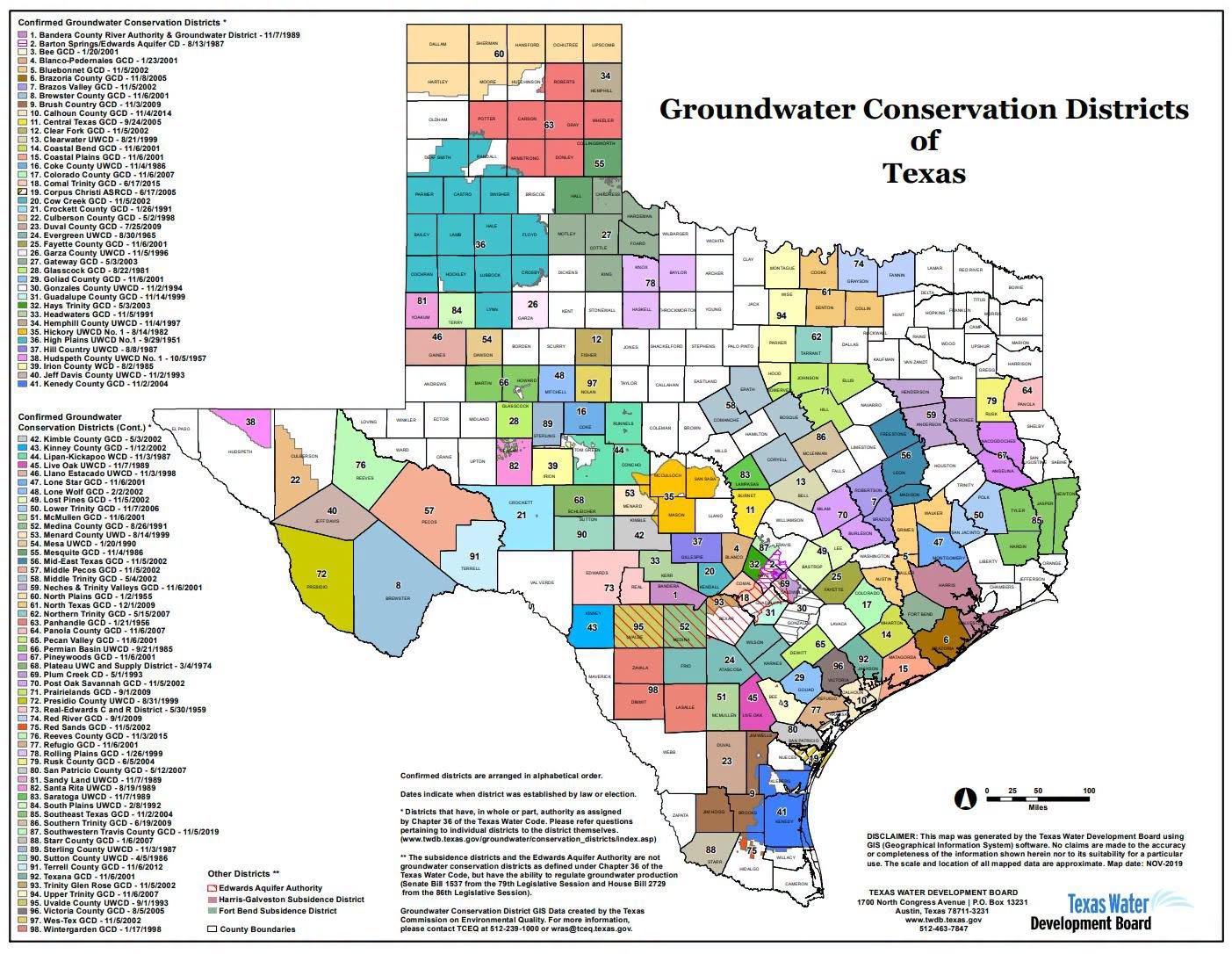
Texas has 98 confirmed groundwater conservation districts as of the latest Texas Water Development Board count. They cover territory in 173 of 254 counties and nearly 70 percent of the state’s land area. Roughly 30 percent of Texas, including significant aquifer territory, has no district at all. In those areas, the unmodified rule of capture still governs.
The Rule of Capture: Why These Districts Exist
In 1904, the Texas Supreme Court decided Houston & Texas Central Railroad Co. v. East. A railroad well pumping 25,000 gallons per day dried up a neighbor’s household well. The neighbor sued and lost. The court adopted the rule of capture: absent malice or waste, a landowner can pump as much groundwater as they want without liability for harm to neighbors. Biggest pump wins.
The rule held for nearly a century. In 1996, Ozarka Spring Water Company was accused of drying up neighbors’ wells in Henderson County while pumping 90,000 gallons per day. The Texas Supreme Court again ruled for the pumper, citing the rule of capture, and effectively told the Legislature to fix the problem itself.
The Legislature answered with Senate Bill 1 in 1997, which revised Chapter 36, expanded district powers, and declared the groundwater conservation district the state’s preferred regulatory vehicle. The courts kept private ownership intact. Districts became the political compromise: local regulation layered on top of a private property right, instead of state-level permitting like surface water.
That history matters to you as a buyer for one reason. Districts regulate around a property right they cannot extinguish. Your groundwater conveys with the land unless it has been severed or reserved, the same way minerals can be. Check title for groundwater reservations before you assume you own what is under your tract.
The Exemption That Covers Most Rural Wells
Here is the single most practical rule in the entire system, including the fine print most summaries skip. Under Texas Water Code Section 36.117, a groundwater conservation district cannot require a permit for a well that meets three conditions: used solely for domestic use or for livestock or poultry, located on a tract larger than 10 acres, and incapable of producing more than 25,000 gallons per day.
All three conditions must hold. If you are buying 15 acres in Grayson County to build a home and run a few head of cattle, your well qualifies. You will typically still need to register the well with the groundwater conservation district and comply with its spacing rules, but no production permit is required.
The exemption has limits worth knowing:
- The 10 acre threshold is the trap. On tracts of 10 acres or less, the statutory exemption does not apply. Some districts extend it by rule. Others require a permit. If you are buying a small tract in a high-growth county, call the district before you close, not after.
- Use controls the exemption, not just capacity. An irrigation well for a commercial hay operation or a well serving a small subdivision usually needs a permit regardless of tract size.
- Spacing still applies. Exempt status does not let you drill on the property line.
North Texas Districts, County by County
The DFW-area groundwater conservation districts are young. In late 2006, TCEQ recommended priority management designation for much of the region, citing a projected 4 million person population increase and overdraft conditions in the Trinity and Woodbine aquifers. TCEQ wanted one large 13-county district. The Legislature created several smaller ones instead between 2007 and 2009.
Interactive Tool
Which groundwater conservation district covers your county?
Data: Texas Water Development Board, Texas Water Code Chapter 36, Texas Alliance of Groundwater Districts. Rules change; verify with the district before drilling.
Hunt County deserves a closer look. No district means no permitting, no spacing rules, and no export fees. It also means zero protection from a neighbor’s high-capacity well. Pure rule of capture applies. For a buyer, that cuts both ways: fewer rules on your side of the fence, and no referee if a commercial operator sets up next door.
Water access is one layer of a county-level story that also includes value. These same eight counties are splitting on price right now, covered in our breakdown of North Texas land prices in 2026.
The Squeeze: Why District Rules Will Tighten
The regulatory environment you buy into today is not the one you will own land in ten years from now. Three pressures are converging.
Aquifer decline is documented, not theoretical. Historic municipal overpumping of the Trinity produced water level declines of 350 to more than 1,000 feet along the I-35 corridor from McLennan County to Grayson County. Wells in the growth corridor are getting deeper and more expensive. Budget accordingly on raw land without a utility connection.
Exurban drilling is accelerating. Parker County led every Texas county in new domestic wells for years running. TWDB driller’s reports show 559 new wells there in 2015 alone, the most in the state, and the district reported a pace near 625 wells per year by 2018, with roughly 25,000 wells already in the county. Wise County ranked in the top 10 statewide over the same stretch. Because most domestic wells are exempt from permitting, spacing is essentially the only management tool districts have. That is the direct collision of exurban land growth and groundwater management, and it is happening inside our listing footprint.
Planning targets constrain future permits. Every groundwater conservation district in Groundwater Management Area 8, which covers the North Texas Trinity and Woodbine, jointly adopts Desired Future Conditions for the aquifers. State models translate those targets into Modeled Available Groundwater, the pumping volume consistent with hitting them. Those numbers cap what districts can permit as demand grows.
Statewide, the 2022 State Water Plan projects the Texas population growing 73 percent to 51.5 million by 2070 while groundwater availability declines 25 to 32 percent. Municipal demand is projected to overtake irrigation as the largest water use category by 2060. As cities and utilities look to rural groundwater, export fee fights will land in district boardrooms. Groundwater becomes the prize, and the groundwater conservation district is where the fight gets refereed.
Due Diligence Before You Buy
Six checks, in order:
- Identify the district. Use the TWDB district map or ask the county. Confirm whether the tract sits inside a groundwater conservation district at all.
- Pull the spacing rules. Minimum distances from property lines and existing wells can constrain where you build on small acreage.
- Confirm the groundwater conservation district permit requirements for your intended use. A homestead well on 15 acres is one thing. A well on 8 acres, or irrigation, commercial, or multi-home use, is another.
- Check title for groundwater reservations. Water rights can be severed like minerals. Make sure the water conveys.
- Budget realistic well costs. Trinity wells in the growth corridor are deeper than they were a decade ago. Get a local driller’s estimate before you commit to raw land.
- Price the no-district counties honestly. Hunt County’s freedom from regulation is worth something. So is the protection you give up.
Frequently Asked Questions
Do I need a permit to drill a well on rural land in Texas?
Usually not for a home or livestock well on more than 10 acres. A groundwater conservation district cannot require a permit for domestic or livestock wells on tracts larger than 10 acres that are incapable of producing more than 25,000 gallons per day. On 10 acres or less, it depends on the district’s rules. Registration and spacing rules typically still apply either way.
What is the rule of capture?
A Texas legal doctrine from 1904 holding that a landowner can pump unlimited groundwater without liability to neighbors, absent malice or waste. Districts modify the rule locally through spacing and permitting. Where no district exists, the rule applies in full.
Which groundwater conservation district covers Collin and Denton County?
The North Texas GCD, created in 2009, covers Collin, Denton, and Cooke Counties. Grayson and Fannin fall under the Red River GCD. Parker and Wise fall under the Upper Trinity GCD. Hunt County has no confirmed groundwater conservation district.
Does groundwater convey with the land in Texas?
Yes, unless it has been severed or reserved in a prior deed. Texas treats groundwater as real property owned in place, similar to minerals. Always check title.
The Bottom Line
A groundwater conservation district is not a deal killer. It is a due diligence item, and one that most buyers skip because nobody at the closing table brings it up. The district determines what your well can do, what your neighbor’s well can do to you, and how tight the rules get as North Texas grows into its next four million residents.
Buying land in Collin, Denton, Grayson, Fannin, Parker, Wise, or Hunt County? Request a Water and Well Due Diligence Brief from North 40 Land Group before you go under contract. We identify the district, pull the spacing and permitting rules for your intended use, and flag groundwater reservations in title so you know exactly what conveys.
REFERENCES (live URLs):
- TWDB, Groundwater Conservation Districts: https://www.twdb.texas.gov/groundwater/conservation_districts/
- TWDB, GCD Facts: https://www.twdb.texas.gov/groundwater/conservation_districts/facts.asp
- Texas Water Code Chapter 36: https://statutes.capitol.texas.gov/Docs/WA/htm/WA.36.htm
- Texas Alliance of Groundwater Districts: https://texasgroundwater.org/
- TWDB, Trinity Aquifer: https://www.twdb.texas.gov/groundwater/aquifer/majors/trinity.asp
- Texas Comptroller, Groundwater: https://comptroller.texas.gov/economy/economic-data/water/2022/ground.php
- Texas Tribune, groundwater rights and the rule of capture (May 2025): https://www.texastribune.org/2025/05/29/texas-water-crisis-groundwater-rights/