Table of Contents
The Texas data center pipeline now totals 140 planned projects representing 75,089 megawatts of additional capacity, according to Cleanview’s April 2026 tracker. That sits on top of 84 operating facilities with 3,789 megawatts. If even half the Texas data center pipeline materializes, Texas will overtake Northern Virginia as the world’s largest data center market before the end of the decade.
That headline number is not in dispute. What’s changing fast is the set of forces now shaping which projects in the Texas data center pipeline actually get built, and where the state’s willingness to absorb the full buildout is running into hard limits.
This piece pulls together four developments from April 2026 that capture the current state of play. It’s a companion to our three-part Texas data center series on buildout, constraints, and land value.
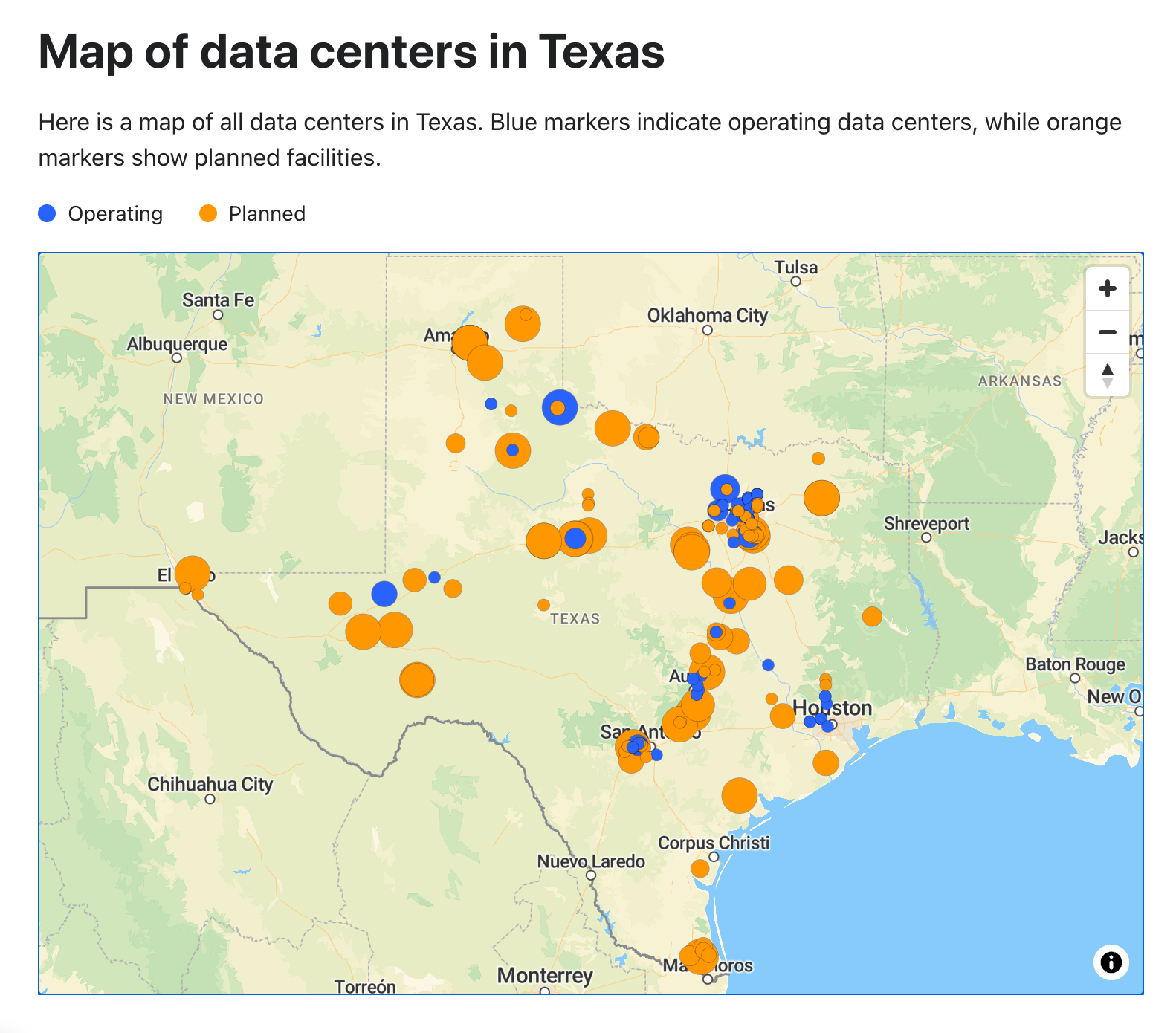
The Texas Data Center Pipeline, Mapped
Cleanview’s data shows the planned Texas data center pipeline concentrated in rural corridors between San Antonio and Dallas, throughout the Panhandle from Amarillo to Lubbock, and across West Texas from Odessa toward Big Bend. Substantial planned footprints also sit in El Paso, Victoria, Palestine, Brownsville, Rockport, and north of Tyler.
The ten largest planned sites in the Texas data center pipeline, ranked by capacity:
| Project | County | Planned Capacity (MW) |
|---|---|---|
| GW Ranch | Pecos | 7,650 |
| Nexus Hubbard | Hill | 7,200 |
| Fermi | Carson | 4,600 |
| Fermi Nuclear | Carson | 4,400 |
| Tract Caldwell Valley | Caldwell | 4,000 |
| Sailfish Comanche Circle | Hood | 3,200 |
| Microsoft Pecos | Reeves | 2,500 |
| Fermi Natural Gas | Carson | 2,000 |
| Eneus Energy Cameron | Cameron | 2,000 |
| Provident | Ellis | 1,800 |
Four of the ten largest planned projects cluster in the Panhandle (Carson and Pecos counties). Two sit in counties directly adjacent to DFW (Hill and Ellis). The rest spread across Caldwell (Austin-San Antonio corridor), Hood (west of Fort Worth), and Cameron (Rio Grande Valley).
For landowners tracking the Texas data center pipeline, the geography tells the story. Rural corridors with cheap land, available transmission right-of-way, and, critically, counties with enough political will to approve large-load rezonings. That last variable is now the binding constraint on where the Texas data center pipeline actually lands.
ERCOT’s Queue Is Much Bigger Than Cleanview’s Map
On April 9, the Texas House State Affairs Committee held a five-hour hearing on the Texas data center pipeline and the grid infrastructure required to support it. ERCOT President and CEO Pablo Vegas testified that the grid operator is now tracking approximately 410,000 megawatts of large-load interconnection requests. Roughly 87% are tied to data centers. Oncor alone reported 650 large-load requests totaling 273,000 megawatts.
For reference, ERCOT’s current peak demand record sits around 85,500 megawatts.
Most of those 410,000 megawatts will never be built. ERCOT and the industry both acknowledge significant speculative submissions from landowners hoping to flip transmission-adjacent parcels. But the ERCOT queue represents real underwriting pressure on Texas land. Every serious developer in the Texas data center pipeline needs site control, power commitments, and water access before ERCOT will take their interconnection request seriously.
ERCOT is now transitioning from a single-project study process to a batch study process that will hold transmission capacity for approved projects. A material change from the first-come, first-served model that produced the current Texas data center pipeline queue. That transition is expected to take effect in late 2026 under Senate Bill 6’s framework, which requires large loads above 75 megawatts to meet financial commitment standards, contribute to interconnection costs, and comply with new planning rules.
Local Friction Is Hardening Around the Texas Data Center Pipeline
The same week Cleanview’s map circulated, Hutto residents in Williamson County turned out in force against Zydeco Development’s request to rezone 40 acres at Ed Schmidt Boulevard and Limmer Loop from a PUD with apartments and commercial to light industrial for a midscale data center. City staff told the planning commission the site is not the best fit for that use. Hutto City Council is scheduled to vote May 7.
Hutto is a bellwether for the Texas data center pipeline. Unlike rural West Texas counties eager for the tax base, Central Texas suburbs with existing growth momentum and water-scarcity concerns are now defaulting to skeptical. Hays County Judge Ruben Becerra formally requested a moratorium on permits for new high-water-demand industrial developments earlier this year. Hood County considered a similar moratorium and voted it down 3-2. These local fights are now the leading indicator for where the Texas data center pipeline actually delivers built capacity.
For landowners, the practical implication is that proximity to a metro is no longer a premium for data center site selection. It can be a disqualifier. Large-acreage tracts in rural Panhandle, West Texas, and deep-rural East Texas counties continue to trade at rising prices per acre. Exurban and metro-edge tracts face increasing entitlement risk.
Financing Is Still Flowing for Qualified Texas Data Center Pipeline Projects
Capital has not slowed. DataBank secured a $2 billion construction loan for its data center campus in Red Oak, Ellis County, per Bisnow’s April 21 Deal Sheet. A TDLR filing shows a 425,170-square-foot two-story facility at a $256 million initial project cost. Ellis County already hosts one of the state’s largest planned data center projects. Provident’s 1,800-megawatt campus. That makes Red Oak one of the densest hyperscale submarkets in the DFW-adjacent section of the Texas data center pipeline.
The $2 billion financing milestone matters for two reasons. First, capital markets remain willing to underwrite large Texas data center pipeline construction despite elevated interest rates and cautious lending elsewhere. Second, Ellis County has now absorbed enough institutional data center investment that it functions as an established submarket, not a speculative one. Comparable to where Loudoun County, Virginia sat a decade ago.
Meta Keeps Escalating in El Paso
Meta’s El Paso campus illustrates how fast scale commitments can shift inside the Texas data center pipeline. The company broke ground in October 2025 on a $1.5 billion, 1,000-acre facility near the Texas-New Mexico line. By March 2026, Meta had increased the commitment to $10 billion. A more than sixfold escalation targeting 1 gigawatt of capacity by 2028.
The liquid-cooled facility is Meta’s third Texas data center and has faced backlash over water usage and a proposed gas-fired power plant that would shift costs to local ratepayers.
The El Paso arc matters because it sets the ceiling for the Texas data center pipeline. Individual hyperscaler campuses in Texas can now scale to $10 billion-plus commitments on a single site. Landowners assembling large contiguous tracts in counties with adequate transmission and water should price accordingly.
What to Watch in the Texas Data Center Pipeline Through 2026
Four items will define where the Texas data center pipeline settles over the next 12 months:
ERCOT’s batch study process rollout. Once projects must reserve transmission capacity with financial commitments, the queue will compress fast. Expect the 410,000-megawatt number to fall substantially as speculative submissions wash out of the Texas data center pipeline.
The 2027 legislative session. SB 6 passed in 2025 and gave ERCOT curtailment authority. The 2027 session is where cost allocation, water use, and local control rules likely get rewritten. Expect the Texas data center pipeline to face materially stricter rules by mid-2027.
Hutto, Hays, and Hood County precedents. Municipal and county-level pushback is the single fastest-moving variable in the Texas data center pipeline. Each high-profile rejection changes the map for the next site selector.
Water, not power, as the binding constraint. Power gets the headlines. Water, particularly in drought-prone regions, is where projects in the Texas data center pipeline will increasingly die. For the broader context on how the buildout is sizing up toward 2030, see our Texas data center market buildout analysis.
FAQ
How large is the Texas data center pipeline?
As of April 2026, Cleanview tracks 140 planned data center projects in Texas totaling 75,089 megawatts of capacity, on top of 84 operating facilities with 3,789 megawatts.
How does ERCOT’s queue compare to the Cleanview count?
How does ERCOT’s queue compare to the Cleanview count? ERCOT is tracking approximately 410,000 megawatts of large-load interconnection requests, with about 87% from data centers. The ERCOT queue includes speculative and early-stage requests that will not all materialize. Cleanview’s 140-project count reflects projects with public disclosure. ERCOT’s queue reflects everyone who has asked for power.
What is Senate Bill 6?
A 2025 Texas law that establishes an interconnection framework for large electricity users above 75 megawatts. It requires financial commitments, contributions to interconnection costs, and compliance with new planning standards. SB 6 also authorizes ERCOT to curtail large loads during grid stress events.
Where are the largest planned Texas data center pipeline projects?
The largest planned projects cluster in the Panhandle (Carson and Pecos counties), Hill and Ellis counties near DFW, Caldwell County between Austin and San Antonio, and Hood County west of Fort Worth.
Why are local governments pushing back now?
Water scarcity, electricity cost allocation, noise, and limited long-term local employment are driving municipal and county opposition. Hays County requested a moratorium. Hood County narrowly rejected one. Hutto residents are actively opposing a rezoning scheduled for a May 7 council vote.
References
- Cleanview Texas Data Center Tracker: Texas Data Center Map — Project List & Locations (April 2026)
- The Center Square: Maps highlight 140 planned data centers in Texas (April 2026)
- KWTX: Texas lawmakers hear testimony on state’s growing data center industry (April 10, 2026)
- Community Impact Austin: Texas legislators begin digging into water use, other data center impacts ahead of 2027 session (April 16, 2026)
- KUT Radio: Texas lawmakers held a hearing on data centers. Here are 4 key takeaways (April 13, 2026)
- Texas Policy Research: House State Affairs Talks Data Centers and Infrastructure
- Community Impact Hutto: Hutto residents air concerns over proposed data center (April 9, 2026)
- KTSM: Texas House discusses the rising needs of data centers (April 9, 2026)
- CNBC: Meta to spend $10 billion on AI data center in El Paso, 1GW by 2028 (March 26, 2026)